

Introduction: Why Laboratory Equipment Prospecting Requires More Than Generic Outreach
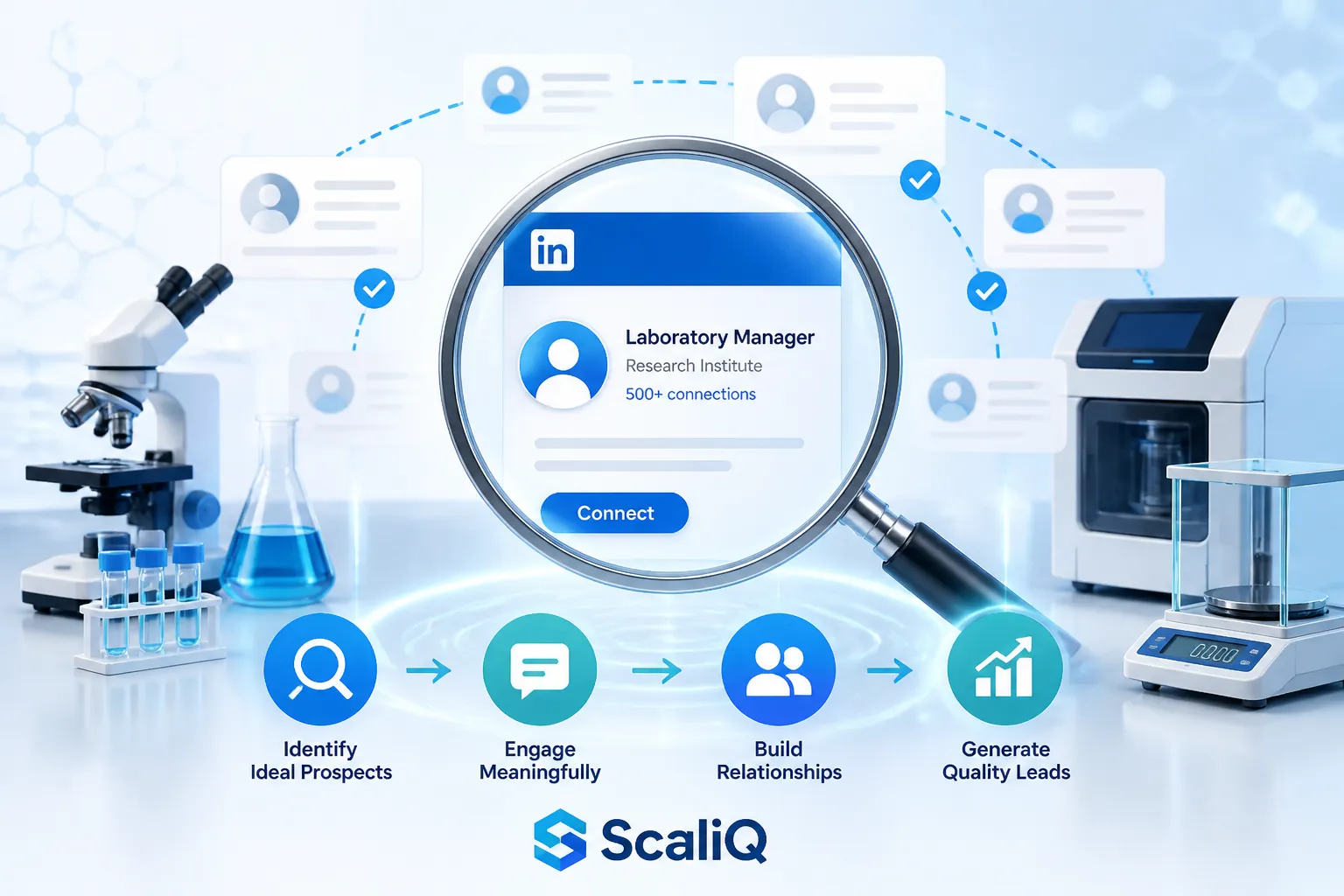
LinkedIn prospecting for laboratory equipment suppliers demands a specialized model built around technical workflows, complex buying committees, long sales cycles, and evidence-led communication. Generic job-title searches and broad “science” targeting consistently produce low-quality leads, wasting resources on prospects who lack the budget, authority, or operational need to evaluate capital equipment.
Equipment recommendations and outreach must be grounded in application requirements, validation needs, workflow fit, throughput, data integrity, and total cost of ownership rather than generic promotional language. This article provides a repeatable LinkedIn prospecting framework tailored for laboratories, biotech firms, manufacturers, clinical organizations, academic facilities, and research teams.
The complete process encompasses account segmentation, persona mapping, buying-signal detection, technical messaging, website alignment, qualification, measurement, and compliance. As a technically oriented resource focused on persona-based segmentation and qualified website journeys, ScaliQ offers this blueprint to help suppliers generate highly targeted laboratory equipment leads and master lab supplier prospecting without relying on unsupported product claims.
H2: Build a Laboratory-Equipment-Specific ICP and Buying Committee Map
Defining a laboratory equipment ideal customer profile (ICP) is the mandatory first step before searching for contacts. Laboratory purchases rarely involve a single decision-maker. Instead, they require consensus across a multi-layered buying committee.
Suppliers must distinguish between the person who uses the equipment on a daily basis, the technical lead who specifies its requirements, the quality professional who validates it, the executive who approves the budget, and the professional who manages procurement. An account-based approach that combines organization-level characteristics with specific application and workflow information is critical. This highly targeted method stands in stark contrast to generic B2B prospecting platforms that prioritize contact volume over technical relevance.
H3: Segment Accounts by Laboratory Type, Application, and Operating Context
Prospecting criteria differ significantly across operating environments. A workflow solution that appeals to an academic facility may not meet the regulatory strictures of a pharmaceutical manufacturer. Segment accounts by:
• Biotech and pharmaceutical organizations.
• Academic research laboratories and core facilities.
• Clinical and diagnostic laboratories.
• Contract research organizations (CROs).
• Industrial laboratories and manufacturing quality-control teams.
Further segment these accounts by application, sample type, laboratory scale, throughput requirements, geography, regulatory context, and installed capability where public information is available. Map each segment to a distinct operational problem—such as capacity constraints, method compatibility, reproducibility, automation, uptime, data integrity, or equipment replacement. Avoid implying that every laboratory segment follows the same procurement process; scientific equipment lead generation requires recognizing the unique purchasing dynamics of different laboratory equipment buyer personas and laboratory procurement decision-makers.
H3: Identify Technical Users, Influencers, Approvers, and Procurement Stakeholders
A robust buyer-role framework ensures comprehensive coverage of the decision-making unit. Key stakeholders include:
• Principal investigators (PIs) and research leads.
• Laboratory managers and core-facility directors.
• R&D and process-development scientists.
• QA/QC leaders and validation teams.
• Manufacturing and facility engineers.
• Procurement, operations, finance, and executive stakeholders.
Each role evaluates equipment through a different lens:
• Technical users: Does the equipment support the required method, sample type, and workflow?
• Laboratory managers: Will it improve capacity, uptime, staffing efficiency, or standardization?
• Quality and validation teams: Can the system support documentation, validation, traceability, and data integrity?
• Procurement and finance: What are the acquisition, service, implementation, and total ownership costs?
Buyer-Committee Mapping Table
Application-specific explanations always outperform generic claims about “better performance.” Technical statements must be supported by specifications, validation information, application notes, or clearly stated limitations to effectively engage B2B laboratory sales prospecting targets and laboratory automation buyers.
H2: Find Qualified Laboratory Equipment Leads on LinkedIn
LinkedIn should be used for identity verification, organizational context, role discovery, and relationship development—not as the sole source of truth for technical qualification. Translating an ICP into actionable LinkedIn research requires organizing searches into three layers: account discovery, persona and role discovery, and qualification and research validation.
Maintain a repeatable process for recording the account name, persona, application, potential need, source of the information, and the planned next action.
H3: Use Firmographic, Role-Based, and Capability Filters
Combine standard and advanced filters to build precise account lists:
• Industry and organization type.
• Company size and geography.
• Job function and seniority.
• Laboratory, R&D, quality, manufacturing, operations, and procurement responsibilities.
• Growth, hiring, facility expansion, or organizational change (where visible).
Search for account clusters—multiple stakeholders within the same organization—rather than isolated individuals. Compare filters for precision and coverage; a broader search does not automatically create a better pipeline. Ongoing research is heavily supported by platform capabilities like those found in LinkedIn Sales Navigator, which offers saved searches, account alerts, lead alerts, and relationship context to streamline LinkedIn B2B outreach and generate high-quality laboratory equipment sales leads.
H3: Create Boolean Searches for Scientific and Operational Roles
Job titles vary widely across scientific organizations. Boolean searches help uncover adjacent functions and synonyms. Combine role terms, organization terms, and application terms relevant to your equipment category.
• Example 1 (Operational): ("Laboratory Manager" OR "Core Facility Director" OR "Lab Operations") AND ("Biotech" OR "Pharmaceutical") AND ("High-Throughput" OR "Automation")
• Example 2 (Quality/Engineering): ("QA/QC" OR "Quality Control" OR "Process Development" OR "Facility Engineer") AND ("Manufacturing" OR "CRO") AND ("Validation" OR "GMP")
Boolean searches are discovery tools, not proof of buying intent. Create separate saved searches for technical users, operational owners, quality stakeholders, and economic buyers to streamline the laboratory procurement process and precisely target laboratory equipment buyer personas for laboratory equipment prospecting.
H3: Validate LinkedIn Profiles With Account-Level Research
Before initiating contact, validate the prospect's relevance:
• Does the individual still hold the stated role?
• Does the organization operate the relevant laboratory or workflow?
• Does the contact have technical, operational, procurement, or executive relevance?
• Does public activity suggest a current project, expansion, hiring need, publication, event, or workflow challenge?
Triangulate LinkedIn data with company websites, scientific publications, funding announcements, job postings, and conference activity. Record confidence levels and unresolved questions before reaching out. While AI can accelerate research for life sciences lead generation, biotech sales prospecting, and research equipment marketing, the supplier remains responsible for technical accuracy, data-quality checks, and human validation.
H2: Detect Buying Intent Before Starting Outreach
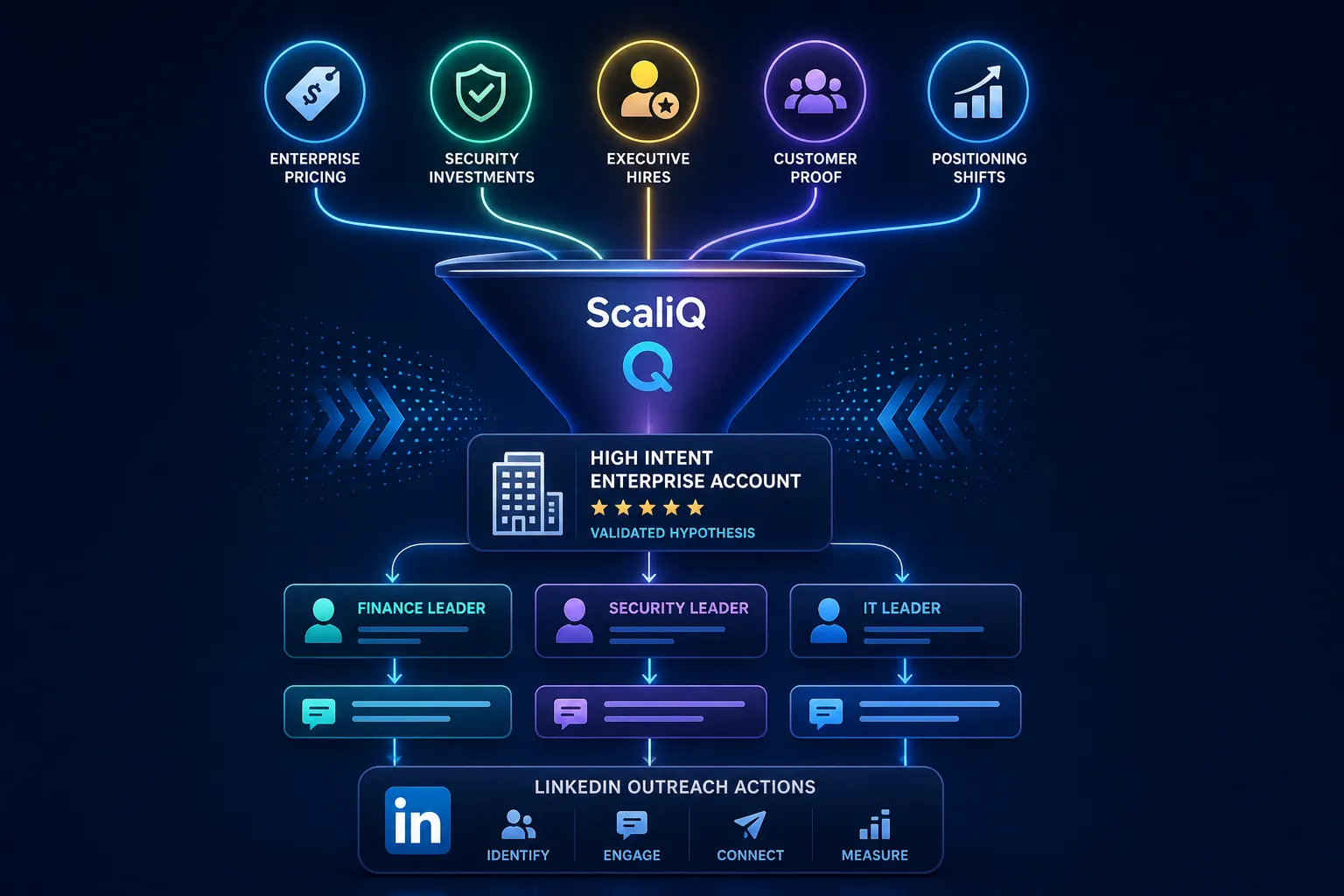
A profile view, a post like, or a relevant job title does not automatically indicate purchase intent. Suppliers must distinguish active equipment needs from general scientific interest by looking for concrete organizational triggers and technical signals.
H3: Build a Laboratory Equipment Buying-Signal Matrix
Evaluate intent by monitoring:
• New laboratory construction, expansion, or site development.
• Hiring for laboratory, quality, process-development, or manufacturing roles.
• New funding, product launches, clinical milestones, or manufacturing scale-up.
• Publications, application changes, or newly announced research programs.
• Regulatory, quality, validation, or compliance activity.
• Equipment replacement cycles, capacity constraints, or workflow bottlenecks.
• Repeat visits to technical pages, application notes, downloads, webinars, or calculators.
Organize these signals by strength, recency, source, and likely buying stage. Combine an account signal with a relevant persona and a matching technical problem.
Sample Scoring Structure:
• High Intent (Sales Ready): Facility expansion announced + Lab Manager hiring + Repeated visits to product-comparison content.
• Medium Intent (Nurture): Recent Series B funding + Broad hiring in R&D + Webinar attendance.
• Low Intent (Monitor): Passive LinkedIn profile engagement + General industry content likes.
This matrix drives scientific equipment lead generation and account-based marketing for laboratories by prioritizing genuine laboratory equipment buying signals.
H3: Distinguish Scientific Interest From Active Evaluation
Low-intent signals, such as broad content engagement, indicate general scientific interest. Stronger indicators—like repeated visits to product-comparison content, technical downloads, method questions, evaluation requests, or facility expansions—signal active evaluation.
Use neutral qualification questions before pushing a contact toward a sales conversation. Record the current workflow or application, equipment category under consideration, capacity or throughput requirement, timing and project stage, validation requirements, and other stakeholders involved. A technically relevant lead may still be early-stage and should receive educational content rather than immediate sales pressure. This ensures a steady pipeline of qualified laboratory equipment leads engaging in legitimate laboratory equipment evaluation, sometimes facilitated by tools like a laboratory equipment ROI calculator.
H2: Create Technical LinkedIn Outreach That Builds Credibility
Turn account and persona research into relevant, evidence-led conversations using a problem-led outreach principle. Begin with a workflow, method, capacity, reproducibility, uptime, or data-integrity issue rather than a product pitch. Personalization must be based on a relevant public or organizational signal, not an exaggerated assumption about the prospect’s needs.
H3: Lead With Workflow Problems Rather Than Product Promotion
Open messages by addressing throughput constraints, reproducibility, manual handoffs, data integrity, validation requirements, or downtime. Structure each message precisely:
1. A credible observation.
2. A relevant technical problem.
3. A useful resource or question.
4. A low-friction next step.
Avoid unsupported performance claims, excessive jargon, and immediate meeting requests. Academic research on B2B social selling highlights how social interactions support relationship development and value creation when grounded in relevance.
Example 1: Technical Content Invitation
Example 2: Discovery-Oriented Question
This approach elevates LinkedIn B2B outreach, technical content marketing for laboratory suppliers, and the generation of laboratory equipment sales leads.
H3: Adapt Messaging to Laboratory Personas
Frame the same equipment capability differently based on the stakeholder:
• Principal investigators: Focus on research capability, method fit, reproducibility, and project requirements.
• Laboratory managers: Emphasize throughput, staffing efficiency, utilization, uptime, and standardization.
• Core-facility directors: Highlight user demand, scheduling, instrument utilization, service, and cross-project flexibility.
• QA/QC leaders: Address validation, traceability, compliance, data integrity, and audit readiness.
• Process-development and manufacturing teams: Discuss scale-up, capacity, process control, interoperability, and supply-chain resilience.
• Procurement and finance: Focus on total cost of ownership, implementation, service terms, and supplier reliability.
Separate technical proof from business outcomes, ensuring each message addresses the exact needs of specific laboratory equipment buyer personas and laboratory automation decision-makers to optimize biotech lead generation strategies.
H3: Sequence Connections, Content, and Follow-Ups Responsibly
Adopt a measured sequence to prevent outreach fatigue:
1. Research the account and persona.
2. Engage with relevant professional or technical content where appropriate.
3. Send a concise connection request with a clear reason for relevance.
4. Share a technically useful resource after acceptance or demonstrated interest.
5. Ask a focused discovery question.
6. Stop, pause, or change the approach when there is no engagement or an opt-out.
Follow-up volume should be governed by relevance, timing, and recipient signals rather than a fixed high-volume sequence. Coordinate LinkedIn activity with email, webinars, technical articles, and CRM records without duplicating messages across channels. The role of social media in the sales process spans prospecting, relationship building, qualification, and account service—requiring restraint and relevance. This reflects B2B LinkedIn outreach best practices for laboratory supplier prospecting and scientific equipment marketing.
H2: Connect LinkedIn Prospecting to Technical Website Content and Conversion Paths
LinkedIn activity must translate into qualified website traffic. Measuring success through impressions or connection volume alone is insufficient. Every segment should have a relevant destination page. Use LinkedIn as a distribution and relationship channel connected to owned technical content, leveraging ScaliQ as a technically oriented resource for connecting persona-based prospecting with relevant website journeys.
H3: Match Each Persona to a Relevant Website Resource
Map personas and buying stages to highly specific assets:
• Laboratory equipment selection checklists.
• Method-comparison worksheets.
• Application notes.
• Validation or implementation templates.
• Total-cost-of-ownership calculators.
• Workflow automation explainers.
• Technical webinars and recorded demonstrations.
Create segment-specific landing pages for biotech, pharmaceutical manufacturing, academic research, clinical laboratories, CROs, and industrial quality-control teams. Align page content with workflow, sample type, throughput, compliance requirements, interoperability, and expected business outcomes. Avoid directing contacts to a generic homepage or a product page lacking technical context. For further guidance, ScaliQ's blog provides a resource hub for technical articles, prospecting guidance, and laboratory-focused educational content supporting technical content marketing for laboratory suppliers, application note lead generation, and laboratory equipment selection.
H3: Design a Low-Friction Laboratory Lead Capture Journey
Guide prospects logically from LinkedIn to conversion:
1. A relevant technical post or message.
2. A segment-specific article or application resource.
3. A downloadable guide, calculator, or webinar.
4. A qualification form or inquiry workflow.
5. A sales or technical application review.
Collect only the information needed for the next step: organization, role, application, equipment category, project stage, and preferred follow-up. Use tagged URLs and campaign naming to connect LinkedIn traffic to website behavior. Understand the distinction between content subscribers, marketing-qualified leads (MQLs), sales-accepted leads (SALs), and qualified opportunities to optimize laboratory equipment lead generation, drive qualified website traffic, and refine the laboratory sales funnel. Platforms like Repliq can serve as an adjacent capability for integrated outreach workflows when verified.
H2: Qualify and Measure Laboratory Equipment Sales Leads
Define success beyond reach, replies, and clicks. A traffic-focused LinkedIn program connects channel activity to technically qualified website sessions and downstream sales progress. Separate awareness, engagement, qualification, and revenue metrics.
H3: Define Lead Qualification Criteria
Establish a rigorous qualification framework:
• Account fit: Laboratory type, organization profile, geography, and relevant capability.
• Persona fit: Technical user, influencer, approver, procurement stakeholder, or executive sponsor.
• Application fit: Equipment category, workflow, sample type, or method relevance.
• Need: Identified bottleneck, replacement requirement, expansion, automation opportunity, or compliance requirement.
• Timing: Exploratory, planned, active evaluation, procurement, or implementation.
• Evidence required: Specifications, application data, validation information, service details, or total-cost analysis.
Route leads appropriately—some need educational nurturing, while others require technical discovery, application support, or commercial follow-up. Use a lead handoff checklist to prevent sales teams from receiving incomplete or context-free contacts, ensuring high-quality laboratory equipment sales leads, precise laboratory lead qualification, and effective B2B laboratory sales prospecting.
H3: Track the Funnel From LinkedIn Activity to Qualified Opportunity
Organize measurement into clear stages:
• Reach and content visibility.
• Profile and account engagement.
• Website sessions from tagged campaigns.
• Engaged sessions and technical resource downloads.
• Marketing-qualified laboratory leads.
• Sales-accepted leads.
• Technical evaluations, demos, or consultations.
• Qualified opportunities and influenced pipeline.
Report by segment, persona, account, content asset, campaign, and equipment category. Connection volume and response rate are leading indicators, not final success metrics.
Practical Tracking Table Example:
This structured approach masters LinkedIn prospecting metrics, laboratory lead generation analytics, and the tracking of qualified opportunities.
H2: Compliance, Data Quality, and Responsible B2B Outreach
Privacy, platform use, commercial communication, and data governance must be explicit parts of the workflow. Professional visibility on LinkedIn does not eliminate privacy, transparency, fairness, or direct-marketing obligations. Document the source and purpose of prospect data, the reason for contact, outreach history, suppression requests, and retention practices.
LinkedIn messages differ from follow-up emails, and different channels carry unique compliance requirements. Always adhere to LinkedIn’s current terms, applicable privacy laws, organizational policies, and legal advice. Review the ICO’s direct marketing privacy guidance regarding publicly available professional data, transparency, profiling, fairness, and direct marketing. When utilizing email follow-ups, strictly observe the FTC’s commercial email compliance guidance covering truthful sender information, non-deceptive subject lines, physical address requirements, and opt-out mechanisms.
Compliance Checklist:
• Accurate identity and purpose clearly stated.
• No misleading personalization.
• Strict respect for opt-outs and suppression requests.
• Controlled data access and retention.
• Human review of AI-assisted research.
• No unsupported technical or performance claims.
• Clear separation between educational content and commercial promotion.
Adhering to these standards ensures compliant LinkedIn B2B outreach, safeguards laboratory prospecting privacy, and maintains robust B2B data governance.
H2: Practical LinkedIn Prospecting Workflow and Implementation Checklist
Advanced laboratory equipment suppliers can adapt this repeatable operating model to systematize their outreach.
The 12-Step Workflow:
1. Define the equipment-specific ICP.
2. Segment target accounts by laboratory type, application, scale, and context.
3. Map technical, operational, quality, procurement, and executive personas.
4. Build role-based LinkedIn searches and account lists.
5. Validate account and contact relevance through human review.
6. Monitor buying signals and first-party engagement.
7. Select the appropriate technical content asset.
8. Write a problem-led, persona-specific message.
9. Sequence follow-up with restraint and clear opt-out handling.
10. Route interested prospects through a relevant website journey.
11. Qualify the lead using application, timing, need, and stakeholder information.
12. Measure progression from LinkedIn activity to qualified opportunity.
Launch Checklist:
• Three to five priority laboratory segments defined.
• Personas mapped for each segment.
• Search terms and filter combinations documented.
• Buying-signal definitions established.
• Approved problem-led message frameworks created.
• Segment-specific landing pages or technical resources ready.
• UTM and CRM tracking conventions implemented.
• Lead handoff and suppression procedures finalized.
Unlike broad prospecting tools that focus on list scale, this LinkedIn prospecting workflow emphasizes laboratory-specific segmentation, technical qualification, content alignment, and compliance-aware research, driving superior lab supplier prospecting and scientific equipment lead generation.
Conclusion
Turning LinkedIn activity into technically qualified laboratory demand requires a strategic pivot away from generic outreach. Start with laboratory segments and workflows, not generic job titles. Map the complete buying committee and use organizational and first-party signals to assess actual intent. Lead every conversation with technical problems and evidence, connecting outreach directly to relevant website resources. Finally, measure success through qualified engagement, sales acceptance, opportunity progression, and influenced pipeline, while treating privacy, data quality, and outreach restraint as non-negotiable operating requirements.
LinkedIn is most effective as part of a connected system involving technical content, account research, website conversion paths, CRM qualification, and sales follow-up. Laboratory equipment suppliers are invited to review their current segmentation today and identify one high-priority persona-to-content journey to optimize their LinkedIn prospecting for laboratory equipment suppliers, secure high-value laboratory equipment leads, and master life sciences lead generation.
E-E-A-T and Author/Brand Credibility Note ScaliQ specializes in technical, scientific communication and persona-based segmentation for laboratories, biotech firms, manufacturers, and research organizations. Our research-driven prospecting frameworks and qualified website journeys are designed to align complex technical solutions with the exact operational needs of scientific buying committees. The information provided is for educational guidance; platform functionality, compliance execution, and specific product performance claims require independent substantiation and legal review where applicable.