

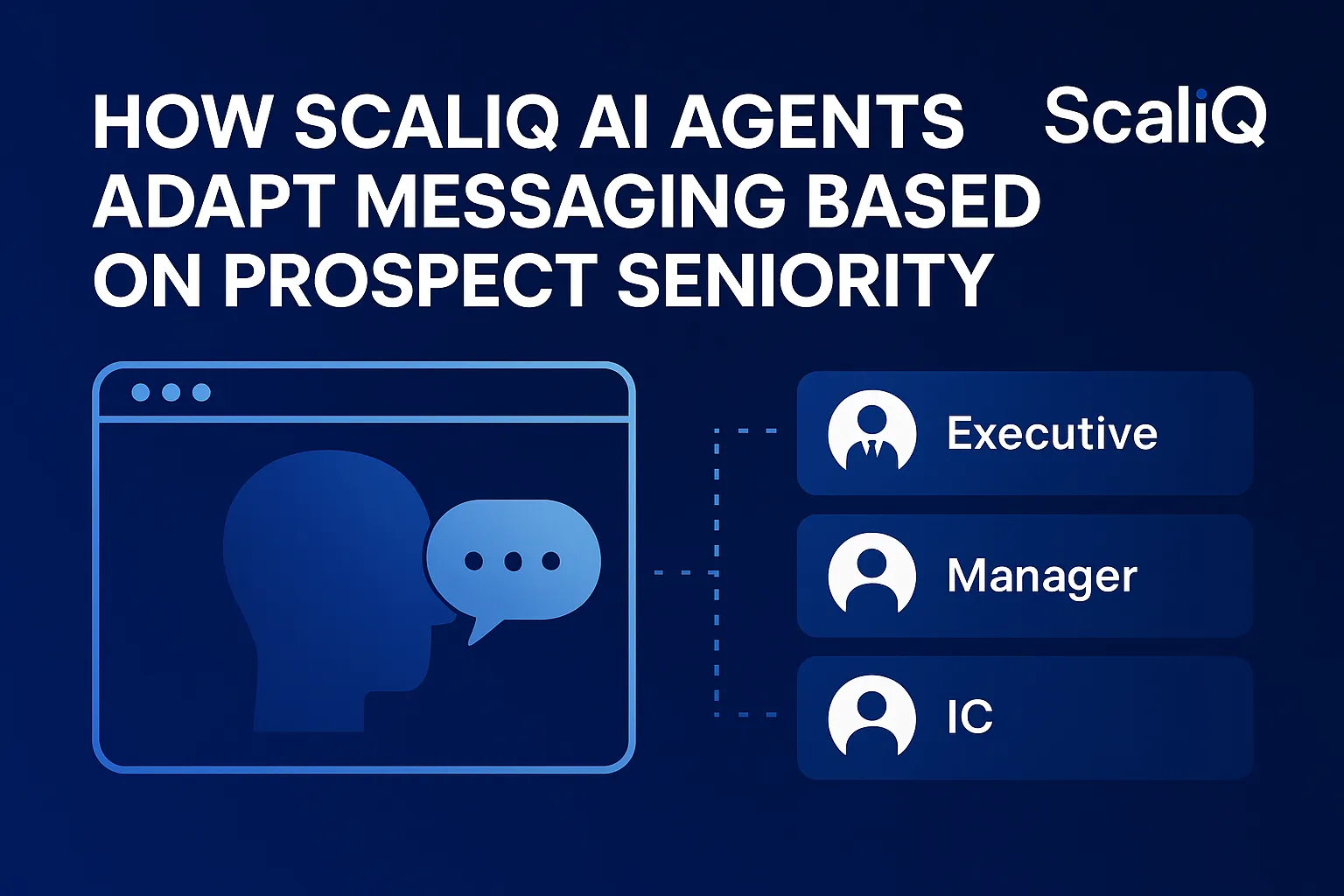
How ScaliQ AI Agents Adapt Messaging Based on Prospect Seniority
Most cold outreach fails not because the product is weak, or the offer is unappealing, but because the tone is fundamentally mismatched to the recipient’s level of seniority. A technical deep-dive that thrills a Senior Engineer will be immediately deleted by a CTO who only has time for high-level strategic impact. Conversely, a high-level ROI pitch sent to an implementation specialist often lacks the actionable detail they need to advocate for a solution.
The challenge for modern sales teams is scale. It is easy to manually rewrite one email for a CEO and another for a Manager, but doing this for thousands of leads is impossible without automation. This is where AI-driven seniority detection and tone-matching models transform the landscape of LinkedIn and outbound engagement.
By leveraging ScaliQ’s proprietary tone-matching and behavioral communication models, revenue teams can now automate the psychological nuance of human communication. This guide explores how AI adapts messaging based on prospect seniority, ensuring your outreach lands with resonance rather than friction.
Why Seniority Requires Different Messaging
Communication psychology shifts dramatically as professionals climb the corporate ladder. The daily reality of an Individual Contributor (IC) revolves around execution and specific tasks, while an executive’s reality is defined by risk mitigation, resource allocation, and long-term strategy. When outreach ignores these realities, it signals a lack of understanding, instantly eroding trust.
Pain points arise when sales teams use a "one-size-fits-all" sequence. Low reply rates are rarely a result of bad luck; they are a result of generic messaging that fails to align with the recipient's cognitive load and decision-making authority. To fix this, we must look at the data behind executive communication patterns.
According to HBR insights on seniority-based communication, effective leadership communication requires brevity and a focus on organizational impact rather than procedural detail. Behavioral AI messaging applies this principle to outbound sales, ensuring that the language used mirrors the recipient's professional elevation.
The Psychological Gap Between IC and Executive Messaging
There is a distinct psychological gap between the micro-level focus of an IC and the macro-level expectations of an executive. An IC is often evaluated on output and technical proficiency. Therefore, they respond well to messages that promise to make their specific workflow easier or their output higher quality.
Executives, however, are evaluated on the performance of the business unit or the entire company. Their decision-making authority dictates that they filter out noise efficiently. They do not want to know how the sausage is made; they want to know if the sausage will increase revenue or reduce liability. Research on communication patterns suggests that higher-status individuals prefer direct, instrumentally oriented communication, whereas lower-status roles often engage more with communal or detailed-oriented language.
Why Generic Outreach Fails Across Seniority Levels
Generic outreach fails because it attempts to average out these differences, resulting in a message that appeals to no one.
• The "Fluff" Failure: Sending a "Hope you're having a great week!" intro to a Fortune 500 CFO often reads as unprofessional and time-wasting.
• The "Weeds" Failure: Sending a 300-word feature list to a VP of Sales will be ignored because they don't have time to translate features into benefits.
Data-driven insights consistently show that executives prefer extreme brevity—often replying to emails under 50 words—while ICs are more likely to engage with concreteness and proof of concept. When you cannot adjust your tone for executives, you lose the decision-maker before the conversation begins.
How AI Detects Seniority and Communication Patterns
Modern AI does not simply look at a job title string like "VP" or "Manager" and apply a tag. Advanced systems analyze a complex matrix of AI signals, including job titles, historical behavioral patterns, posting style, and responsibility indicators found in public profiles.
ScaliQ’s seniority inference system goes beyond keyword matching. It utilizes proprietary tone-matching models to understand the implied authority of a prospect. By analyzing linguistic markers—such as the use of strategic verbs versus tactical nouns—AI can determine the appropriate communication style for that specific individual. This contrasts sharply with competitors like Clay, Copy.ai, or Instantly, which often rely on static templates or basic variable replacement rather than dynamic behavioral adaptation.
To understand the depth of this analysis, we look to Stanford AI and NLP research, which demonstrates how Natural Language Processing can classify social hierarchy and intent through text analysis.
Data Signals Used in Seniority Detection
AI seniority detection models rely on a convergence of data points to infer a prospect's true standing:
• Explicit Signals: Job titles (e.g., "Head of," "Lead," "Chief"), hierarchy keywords, and years of experience.
• Implicit Signals: "Scope-of-responsibility" language in bios (e.g., "P&L responsibility," "Strategic oversight" vs. "Implementing," "Coding").
• Behavioral Indicators: Detected from public LinkedIn activity, such as whether a user posts about industry trends (Executive behavior) or specific tool tutorials (IC behavior).
Tone Analysis & Role Pattern Recognition
Once the role is inferred, the AI must determine the correct output tone. Tone-matching models analyze the prospect's own writing style to mirror their preferred level of density and formality.
• Urgency Markers: Does the prospect speak in short, punchy sentences? The AI adapts to match.
• Strategic Depth: Does the prospect discuss "digital transformation" or "server uptime"? The AI aligns the value proposition accordingly.
This allows for true behavioral insights to guide the drafting process, moving beyond simple personalization.
Ensuring Safe, Compliant AI Behavior
In the era of autonomous agents, trust is paramount. All data extraction and processing must be strictly compliant with privacy laws (GDPR, CCPA) and platform Terms of Service. ScaliQ emphasizes trustworthy AI that avoids "hallucinations" or making up facts about a prospect.
Adhering to NIST guidelines on AI behavior, responsible AI messaging ensures that automation remains ethical, transparent, and accurate, processing only publicly available professional data to enhance relevance without infringing on privacy.
Role-by-Role Tone Adaptation Examples
The power of seniority-based messaging is best understood through examples. Below is how a single core value proposition—"We help teams automate data entry"—shifts across four distinct levels of seniority.
For more role-specific outreach templates and deep dives into persona-based writing, you can explore the ScaliQ blog.
Individual Contributors (ICs)
• Focus: Removing friction, ease of use, technical compatibility.
• Tone: Practical, instructional, resource-driven.
• Keyword Strategy: ic messaging style, practical outreach tone.
Example:
Managers
• Focus: Team efficiency, hitting quotas, removing blockers.
• Tone: Operational efficiency, team improvement, tactical outcomes.
• Keyword Strategy: manager outreach, operational messaging.
Example:
Directors
• Focus: Quarter-over-quarter growth, cross-functional alignment, budget justification.
• Tone: Strategic initiatives, cross-functional impact, long-term value.
• Keyword Strategy: director-level messaging, strategic tone adaptation.
Example:
C-Suite Executives
• Focus: Bottom line, risk reduction, competitive advantage, ROI.
• Tone: Concise, high-leverage insights, risk reduction, ROI clarity.
• Keyword Strategy: executive outreach, c-level messaging.
Example:
Benefits of Adaptive Outreach vs Static Templates
Static templates produce diminishing returns. As buyers become more sophisticated, they develop "banner blindness" to templated emails. Adaptive outreach benefits the sender by dynamically adjusting to the recipient's context, significantly improving trust and relevance. Market-level data suggests that adaptive outreach can increase engagement by up to 30% compared to static sequences.
For further reading on outbound personalization ecosystems and how different tools fit together, check out insights from Repliq.
Efficiency Gains from Automated Tone Adjustment
The primary benefit of AI tone adaptation is scalable personalization.
• Time Savings: It takes a human 5-10 minutes to research and rewrite an email for a specific persona. AI does this in milliseconds.
• Consistency: Humans get tired; their tone slips. AI maintains a consistent, optimized tone across large lead lists, ensuring every Director gets a Director-level message.
Why Competitors Fall Short
Many personalization tools in the market, such as Clay, Copy.ai, Instantly, or Apollo, excel at data enrichment or basic text generation. However, they often fall short in behavioral modulation. They might insert a "recent news snippet" into an email, but they rarely fundamentally restructure the argument based on the seniority of the recipient. True seniority detection alternatives must go beyond "filling in the blanks" to actually changing the conversation's frame.
How ScaliQ’s Tone-Matching Models Elevate Engagement
ScaliQ distinguishes itself through proprietary tone-matching layers that sit on top of standard LLMs. This is not just a wrapper for GPT-4; it is a specialized seniority inference logic designed for B2B revenue teams.
The system is built on the foundation that every message must pass a "relevance check" against the prospect's inferred persona. ScaliQ models adapt four key dimensions:
1. Length: Shorter for executives, longer for ICs.
2. Tone: Direct for leaders, collaborative for contributors.
3. Structure: "Bottom line up front" (BLUF) for C-Suite, narrative structure for others.
4. Strategic Depth: High-level ROI vs. technical specs.
To understand the validation of these technologies, we reference the U.S. National AI Initiative (AI.gov) standards, which emphasize the importance of context-aware AI systems in modern commerce.
Technical Overview (Non-Technical Audience Friendly)
The workflow for ScaliQ’s AI messaging is a multi-step process:
1. Detect: The system ingests public profile data and identifies the prospect's role and seniority.
2. Classify: It assigns a "Persona Score" (e.g., Strategic Decision Maker vs. Technical Implementer).
3. Adapt: The generative model drafts the message using specific linguistic constraints for that class.
4. Optimize: A final layer reviews the draft against successful reply patterns for that specific seniority level before sending.
Behavioral Communication Insights Built Into ScaliQ
ScaliQ is trained on millions of successful B2B interactions. It recognizes that behavioral communication is the key to unlocking cold leads. By integrating communication pattern research, the model understands that a "VP of Engineering" responds to different psychological triggers than a "VP of Sales," even though they share the same seniority level. This dual-layer of Seniority + Function creates the ultimate personalized experience.
Tools, Resources, and Future Trends
The future of AI outreach is moving toward fully autonomous agents. We are transitioning from "copilots" that help us write, to "agents" that autonomously manage multi-step conversations.
Future Trends to Watch:
• Multi-Turn Context: AI that remembers the tone of the previous reply and adjusts the follow-up accordingly.
• Deep Role Inference: Detecting "Shadow IT" buyers or influencers who don't hold the official title but hold the power.
• Omnichannel Adaptation: Agents that shift tone not just between roles, but between channels (e.g., being more casual on WhatsApp vs. formal on Email).
To stay ahead, teams must invest in tools that prioritize behavioral data over simple contact scraping.
Conclusion
The primary reason outbound campaigns fail is rarely the product—it is the packaging. Seniority-specific tone is the missing ingredient that turns a "delete" into a "reply." Executives demand brevity and ROI; managers demand efficiency; contributors demand utility.
AI-powered tone adaptation gives revenue teams a scalable way to meet these diverse expectations without hiring an army of copywriters. By leveraging ScaliQ’s role-adaptive outreach capabilities, you ensure that every message lands with the right weight, tone, and intent.
Ready to stop sending generic emails? Explore how ScaliQ’s AI Agents can transform your engagement rates today.