


How to Target Companies Expanding Their Sales Teams
Sales hiring is one of the most reliable leading indicators of revenue investment and go-to-market expansion. Yet, many sales teams discover this hiring activity far too late, treat every job posting equally, or rely on generic lead lists that lack actionable context. When outbound teams treat a single job opening as an automatic buying signal, they waste effort on misaligned outreach and miss the broader strategic picture.
This guide will show you how to identify, validate, score, and act on companies expanding their sales teams. A sales hiring signal is not a guaranteed buying signal; it becomes commercially valuable only when combined with hiring velocity, role type, seniority, recency, company context, and commercial evidence. By mastering this workflow, you can discover target accounts, distinguish true growth from routine replacement hiring, prioritize your best opportunities, identify the correct stakeholders, and create highly relevant LinkedIn outreach triggers.
Designed for intermediate B2B professionals familiar with CRM systems, LinkedIn, and outbound sales, this process transforms raw data into actionable pipeline. As a growth-focused intelligence and prospecting resource, ScaliQ helps teams translate these complex sales hiring patterns into prioritized accounts and tangible revenue opportunities.
Why Sales Hiring Is a Valuable Prospecting Signal
Sales hiring signals indicate a direct investment in revenue growth, market expansion, customer acquisition, or go-to-market execution. When a company dedicates budget to expanding its revenue team, it is actively trying to solve a commercial problem. However, an open role alone does not prove purchase intent or immediate budget availability for your specific product or service.
Sales hiring is valuable because it is often an earlier observable signal than a completed company announcement, a press release, or a formal vendor search. As headcount grows, hiring patterns expose adjacent demand for sales enablement, CRM implementation, revenue operations, data enrichment, automation, and broader GTM services.
This approach is fundamentally different from generic list building. The goal of B2B prospecting triggers is not simply to find companies that fit a static profile, but to identify companies experiencing a relevant, observable business change. It is important to consult official job-opening data to understand the broader difference between raw job openings, actual hires, and macroeconomic labor-demand indicators. A job posting is a clue, not confirmed revenue intent. While broad prospecting platforms may expose generic hiring or company-growth data, ScaliQ’s unique opportunity is helping teams interpret the sales-specific pattern and connect it to an actionable next step.
What Makes a Sales Hiring Signal Commercially Useful?
A commercially useful signal possesses five characteristics: relevance, recency, confidence, business context, and an identifiable stakeholder. Multiple related openings are generally more informative than one isolated listing because they demonstrate a coordinated strategy rather than a simple backfill.
To maximize the value of sales recruitment intent data, you must combine hiring data with firmographic, technographic, funding, geography, and employee-growth context. A surge in revenue team expansion only matters if the company fits your ideal customer profile (ICP). Ultimately, each intent signal for prospecting should lead to a hypothesis to validate through outreach, not an unsupported assumption about the prospect’s internal budget.
The Main Types of Sales Team Growth Signals
Sales team growth signals should be organized by what they reveal about a company’s broader revenue strategy. Different roles imply entirely different operational needs and buyer groups. To build a complete picture of sales headcount growth, you must capture the role title, department, seniority, location, job age, description, and any evidence of repetition for every target account.
Frontline Capacity Hiring
Frontline capacity hiring includes repeated openings for SDRs, BDRs, account executives, sales representatives, and territory sales roles. When you see companies hiring salespeople in volume, several similar openings indicate a clear plan to increase pipeline coverage or selling capacity.
It is vital to distinguish between a single replacement role and repeated SDR hiring or account executive hiring across multiple teams, territories, or segments. Always check whether these frontline roles are concentrated in a new market, targeting a specific customer segment, or expanding into a new geography, as this dictates the angle of your outreach.
Sales Leadership Hiring
A new VP of Sales, Head of Sales, sales director, or regional sales leader often signals a fundamental change in commercial strategy. VP of Sales hiring signals are particularly powerful. There is a distinct difference between a startup hiring its first sales leader (indicating a shift from founder-led sales to a structured process) and a mature enterprise adding another layer of management (indicating a need to scale).
Sales leadership hiring implies upcoming initiatives like building a sales process, introducing forecasting discipline, scaling a team, or entering a new market. Outreach should be directed toward the new leader, but you should also consider founders, recruiting stakeholders, and RevOps owners who are supporting this revenue team expansion.
Revenue Operations, Enablement, and Sales Engineering Roles
Revenue operations hiring, sales enablement demand, and sales engineering roles reveal a company’s operational maturity and scaling complexity. These roles directly connect to potential needs in CRM architecture, data quality, sales automation demand, process design, training, and sales productivity. A company hiring both frontline sellers and operational support demonstrates a much stronger, more sustainable expansion pattern than a company hiring a single salesperson.
Geographic or Segment Expansion
Location-specific roles, language requirements, territory ownership, or industry specialization strongly indicate market expansion. These go-to-market hiring signals show where a company is placing its bets. However, the rise of remote and distributed work makes geography less reliable as a standalone qualifier. Treat geographic sales expansion signals as one input alongside role type, seniority, hiring velocity, and overall company priorities.
How to Find Companies Expanding Their Sales Teams
Finding companies expanding their sales teams requires a repeatable discovery process rather than a list of disconnected tools. Start with a defined ideal customer profile (ICP) that includes company size, industry, geography, technology environment, sales motion, and service fit.
You can search across LinkedIn, company career pages, job boards, and applicant-tracking-system (ATS) pages. Instead of relying on browser tabs or memory, record your evidence in a structured account list. When executing B2B lead generation using job postings, it is crucial to understand how to research employers to verify job information across employer websites and other reliable public sources.
Use Role and Department Search Patterns
Create dedicated search groups for sales development representative hiring (SDR/BDR), account executive, sales manager, VP of Sales, sales operations, RevOps, enablement, and sales engineering roles. Use combinations of job title, department, seniority, company size, industry, and location to filter the noise.
Because companies use inconsistent naming conventions for similar functions, include variations in job titles. Separate your discovery searches (finding the sales job postings) from your qualification searches (vetting the sales hiring signals) to avoid treating every search result as an immediate priority account.
Capture the Right Account-Level Data
To effectively use sales recruitment intent data, capture the right fields: company name, website, open role, department, seniority, job location, posting date, source, repeated openings, and relevant job-description language.
Supplement this with context fields such as employee growth, company segment, funding, or commercial announcements when available. Record the likely stakeholders for account-based marketing trigger events, including sales leadership, recruiting, RevOps, enablement, and operations. Always flag duplicate, stale, syndicated, or unclear listings for manual review to ensure your sales prospecting data is accurate.
Validate the Signal Before Outreach
Never automate outreach without validating the signal. Confirm that the role is still active and verifiably connected to the company. Check whether several listings represent genuine separate openings or simply duplicated versions of the same role posted in different cities.
Compare the job description with the company’s apparent sales motion, market, and organizational structure. High-quality sales hiring intent data is backed by supporting evidence, such as multiple sales roles, a leadership appointment, employee growth, funding context, or a market announcement. This validation is the cornerstone of effective account prioritization and leveraging sales expansion signals.
How to Distinguish Growth Hiring from Replacement Hiring
One of the primary challenges in sales hiring prospecting is that not every sales job opening represents net-new team expansion. Replacement, capacity, leadership, and market-expansion hiring must all be treated differently. Instead of forcing every account into a binary “intent” or “no intent” category, use confidence levels to measure sales headcount growth.
Indicators of Replacement Hiring
Replacement hiring is often characterized by one isolated opening, an identical role appearing repeatedly over a long period, or a listing that lacks any expansion context. Clues such as a departed employee, explicit backfill language in the job description, or an unchanged territory suggest replacement rather than capacity growth.
While replacement hiring can still create opportunities—especially if a new decision-maker is brought in—the outreach hypothesis must reflect this reality. Avoid claiming that any single clue definitively proves replacement hiring; instead, use these indicators to shape your approach to the sales job opening.
Indicators of Net-New Expansion
Net-new sales team expansion is signaled by repeated hiring for similar roles within a recent, condensed period. Look for multiple levels of the sales organization being hired at once, such as SDRs, AEs, managers, and RevOps support.
High hiring velocity into new territories, customer segments, languages, or market-specific responsibilities strongly indicates growth. Confidence in this revenue team expansion increases significantly when the hiring activity aligns with employee growth, recent funding, leadership changes, or other commercial evidence.
A Practical Hiring Signal Confidence Model
Assign a confidence level to your B2B prospecting triggers based on evidence quality:
• Low confidence: One unclear or stale posting with no supporting context.
• Medium confidence: Recent role activity with some company or organizational support.
• High confidence: Multiple recent sales roles, relevant leadership or operations hiring, and corroborating growth signals.
This sales hiring score model prioritizes research and outreach; it does not guarantee a buying decision, but it ensures your account prioritization is rooted in logic.
Build a Sales Hiring Signal Scorecard
A sales hiring signal scorecard provides a practical framework for ranking accounts before investing time in research or outreach. Use transparent criteria that your sales teams can inspect, understand, and adjust. The score should reflect your ideal customer profile and your specific offer, not just the raw volume of open jobs.
Suggested Scoring Dimensions
• Hiring pattern: Score based on whether there is one role, repeated roles, multiple functions, or leadership combined with frontline hiring.
• Recency: Prioritize current activity and define a strict review window (e.g., jobs posted in the last 30 days) to gauge sales hiring velocity.
• Role seniority: Distinguish frontline hiring from leadership, RevOps, enablement, and sales engineering signals.
• Business fit: Compare company size, industry, geography, sales motion, technology stack, and likely service needs against your ICP.
• Evidence quality: Confirm the source, remove duplicates, and ensure the signal is active and attributable to the company.
Prioritize Accounts by Signal Combinations
A combination of several moderate signals is often stronger than one dramatic but unverified signal. For example, multiple SDR or AE openings combined with a sales leadership hire is a potent indicator of go-to-market hiring signals.
Other strong combinations include new territory roles paired with relevant language requirements, or frontline hiring backed by RevOps and enablement hiring. Route the highest-confidence sales expansion signals to immediate research and outreach, while placing lower-confidence intent signals for prospecting into a monitoring sequence.
Create a Trigger-to-Offer Matrix
Map common hiring patterns to likely business problems, framing them as conversation hypotheses rather than presenting assumptions as facts.
• SDR hiring: May indicate needs for lead data, prospecting process design, sales automation demand, and coaching.
• AE hiring: May indicate needs for pipeline generation, sales process refinement, CRM visibility, and enablement.
• VP of Sales hiring: May indicate needs for GTM strategy, forecasting discipline, team design, and an operating cadence.
• RevOps hiring: May indicate needs for CRM implementation, data quality, workflow automation, and reporting.
• Sales enablement demand: May indicate needs for onboarding, content management, training, and productivity infrastructure.
Turn Sales Hiring Signals Into LinkedIn Outreach Triggers
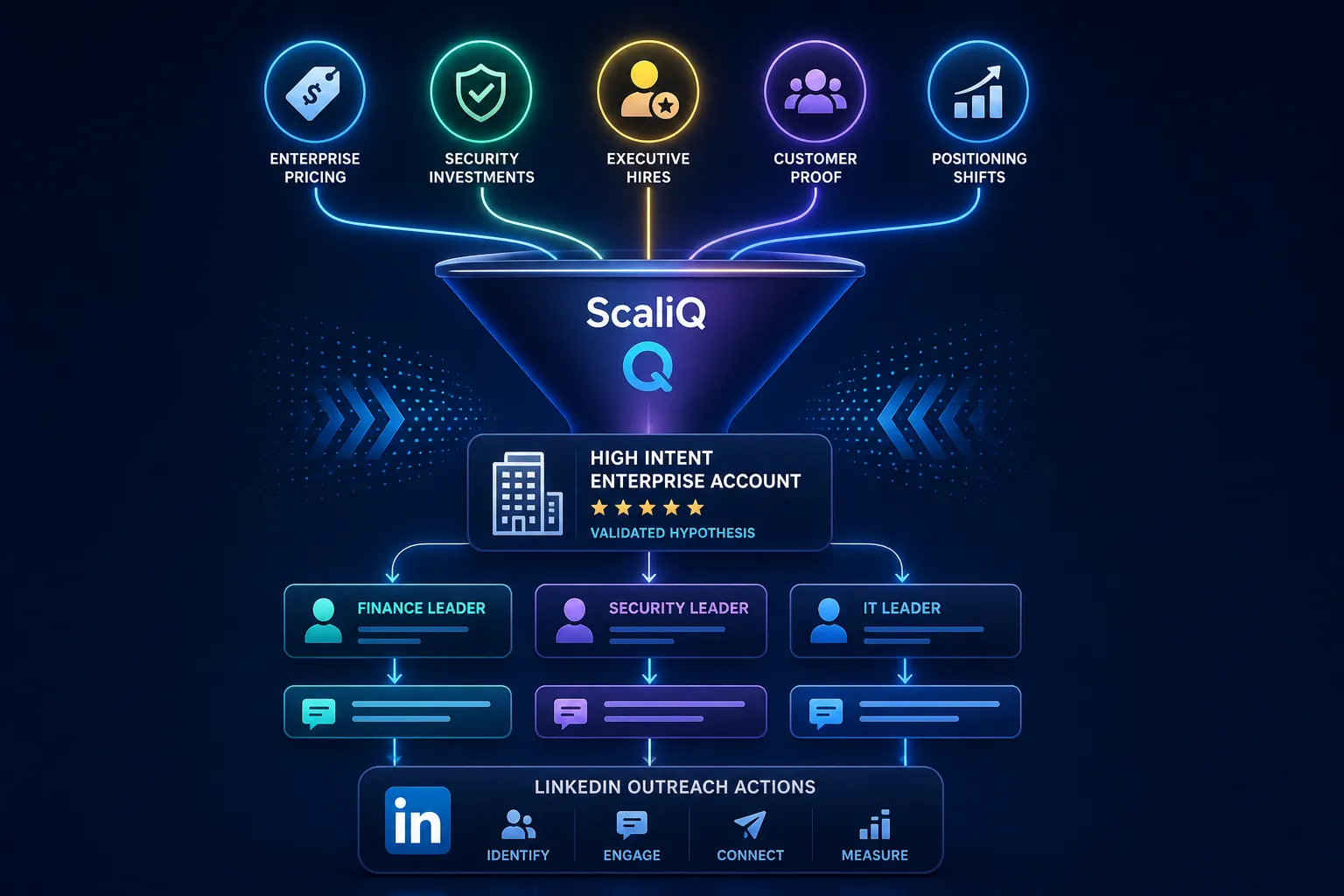
Moving from account identification to timely, relevant outreach requires discipline. The hiring signal should improve the conversation, not become a superficial personalization token. The workflow is simple: validate the account, infer a business question, identify the responsible stakeholder, create a useful message, and monitor outcomes.
Match the Message to the Stakeholder
The same hiring signal must produce different messages for different stakeholders:
• Sales leader prospecting: Focus on capacity, pipeline coverage, ramp time, process consistency, or expansion execution.
• Recruiter or talent leader: Focus on hiring volume, role coordination, candidate flow, or the operational impact of scaling.
• RevOps outreach: Focus on data quality, CRM workflows, reporting, automation, and handoffs.
• Sales enablement outreach: Focus on onboarding, playbooks, training, and rep productivity.
Outreach Message Structure
Effective LinkedIn outreach triggers follow a specific structure. Open with an observable context point, such as the pattern of roles being advertised. Add a relevant hypothesis—suggesting that the hiring pattern may create a need for consistent data, onboarding, automation, or GTM execution.
Offer a useful asset, checklist, benchmark, or diagnostic rather than making an unsupported pitch. Close with a low-friction question that invites correction or clarification. Always include clear opt-out and human-review practices to ensure scalable, compliant trigger-based outreach.
Outreach Examples by Hiring Pattern
• Several SDR roles: Connect the signal to lead quality, list building, workflow consistency, or SDR ramping.
• First VP of Sales role: Connect the signal to building the operating system, process, reporting, and predictable pipeline.
• Multiple AEs in a new segment: Connect the signal to territory design, account prioritization, and market-specific GTM execution.
• RevOps and sales operations roles: Connect the signal to CRM hygiene, data integration, and automation.
Ensure every sales hiring outreach example uses cautious language such as “often,” “may,” or “I noticed,” rather than claiming absolute knowledge of the company’s internal priorities.
Timing and Follow-Up
Fresh, validated hiring activity is infinitely more useful than stale job-posting data. Act quickly on sales hiring triggers. Use a measured follow-up sequence that adds new context instead of simply repeating the original observation. Use different follow-up angles for sales leadership, recruiting, RevOps, and enablement stakeholders. Track how LinkedIn outreach timing affects replies, meetings, opportunities, and ultimately, your B2B prospecting workflow pipeline.
Tools and Workflow Considerations for Sales Hiring Prospecting
A robust revenue intelligence workflow requires coordinating LinkedIn, job boards, company career pages, ATS pages, enrichment tools, CRM systems, and outbound execution platforms. Because each source reveals only part of the account picture, your workflow must minimize tool switching and keep signal evidence connected directly to the account record.
LinkedIn and Professional Network Research
Use LinkedIn to review company context, employee roles, leadership changes, job activity, and relevant stakeholders. However, a successful LinkedIn sales prospecting strategy requires combining platform data with independent verification and structured account notes. LinkedIn outreach triggers are powerful, but the platform should not be framed as a complete, infallible source of buying intent.
Job Boards, Career Pages, and Applicant-Tracking Systems
Job boards are excellent for discovering role volume, title patterns, location, and seniority. Always check company career pages or applicant-tracking systems to confirm that roles are current and attributable to the company. Be highly cautious of syndicated, duplicated, stale, or incomplete listings. Use official job-search resources as a trustworthy reference point to understand how job information is published and where legitimate employment opportunities can be verified.
ScaliQ and RepliQ in the Workflow
To operationalize this data, ScaliQ acts as the intelligence layer for interpreting sales hiring patterns, validating account context, and prioritizing outreach opportunities. Once accounts and triggers have undergone human review and qualification, RepliQ can support scalable outreach and execution. The distinction is critical: AI-assisted prospecting for signal detection and prioritization must precede outbound workflow automation. Human review, transparent evidence, and accuracy checks are non-negotiable before an account enters an automated sequence.
Comparison With Broad Prospecting Platforms
Broad platforms play distinct roles in the ecosystem. Clay hiring signals can support enrichment and multi-source workflows. Apollo hiring prospecting can connect account discovery with contact and outreach workflows. LinkedIn Sales Navigator supports professional-network research and alerts.
The gap this article addresses is separating true sales-function expansion from generic hiring and turning that nuanced data into a transparent prioritization model. ScaliQ focuses specifically on sales-expansion interpretation, validation, and account prioritization rather than competing solely on database size. Remember, no single tool should be treated as a standalone buying-intent guarantee.
Measure Whether Hiring-Based Prospecting Creates Revenue
To succeed, you must shift the focus from raw activity metrics to signal quality and commercial outcomes. A strong workflow proves which hiring patterns produce meaningful conversations and pipeline. Analyze your sales hiring signal performance by trigger type, stakeholder, company segment, recency, and confidence level.
Metrics to Track
• Data quality: Track the active-role rate, duplicate rate, stale-signal rate, and the percentage of accounts with verified context.
• Engagement: Measure reply rate, positive reply rate, LinkedIn acceptance rate, and response time.
• Pipeline: Monitor meetings booked, qualified opportunities, opportunity conversion, and sourced pipeline attribution.
• Revenue: Track closed-won revenue and return on effort by hiring-signal category.
Establish a baseline from your team’s own sales hiring prospecting metrics rather than relying on invented industry benchmarks.
Test Signal Types and Message Variants
Continuously test your sales hiring signal testing hypotheses. Compare the performance of single-role accounts against multi-role accounts. Compare frontline hiring against leadership hiring, RevOps hiring, and enablement hiring. Test LinkedIn outreach testing messages that lead with an observation, an operational hypothesis, an educational resource, or a diagnostic offer. Review negative responses and no-response accounts to refine your scorecard and account prioritization rules.
Create a Feedback Loop
Feed sales feedback directly back into the account record in your CRM. Note if there was an inaccurate signal, wrong stakeholder, stale job, poor fit, or highly useful timing. Update your scoring weights based on actual meetings and opportunities rather than subjective enthusiasm. Maintain separate sales signal optimization rules for different industries, company sizes, sales motions, and service offers to ensure a precise revenue intelligence workflow.
Common Mistakes and Compliance Considerations
There are inherent risks in overinterpreting public hiring information, relying on stale records, and automating irrelevant outreach. The objective is useful, transparent prospecting—not surveillance or unsupported personalization. Compliant sales prospecting must always be the priority.
Mistakes That Reduce Signal Quality
Avoid these common sales hiring prospecting mistakes:
• Treating every sales job posting as definitive proof of budget or imminent purchase.
• Ignoring replacement hiring and duplicated listings.
• Failing to capture the job’s age, source, seniority, or department.
• Sending the exact same message to a recruiter, a VP of Sales, and a RevOps leader.
• Automating B2B outreach personalization before validating the account, role, and likely business problem.
Responsible Data and Outreach Practices
Responsible sales automation requires transparent, relevant, and human-reviewed outreach based on observable business context. You must respect platform rules, privacy expectations, contact preferences, and applicable outreach requirements.
Never imply private knowledge or state that a company definitively needs a specific service based on a job posting. Maintain accurate records and always provide a clear, easy way for recipients to opt out. Privacy-conscious outreach and compliant B2B prospecting protect your brand reputation and ensure long-term outbound success.
Conclusion: Turn Sales Hiring Signals Into Better-Timed Prospecting
Targeting companies expanding their sales teams requires a disciplined, structured approach. The process is clear: discover sales hiring activity, validate the pattern, distinguish true growth from replacement hiring, score the account, map the likely business need, identify the right stakeholder, and personalize the outreach.
The strongest revenue team expansion opportunities come from combinations of signals rather than isolated job postings. By connecting these hiring patterns to adjacent demand for enablement, data, automation, RevOps, CRM, and GTM services, you position yourself as a strategic resource rather than just another vendor. Build a repeatable, measurable workflow instead of relying on manual searches or generic lead lists.
ScaliQ is dedicated to helping teams leverage sales hiring patterns, demand signals, data, automation, and GTM services ethically and effectively. If you want to turn sales hiring activity into structured prospecting opportunities, explore ScaliQ for a more focused approach to identifying and prioritizing accounts. For more strategies on sales intelligence, growth signals, and revenue-focused prospecting, visit ScaliQ's blog.
Frequently Asked Questions
How can you identify companies that are expanding their sales teams?
You can identify companies expanding their sales teams by combining data from job postings, repeated openings, leadership appointments, employee growth, company context, and commercial announcements. It is essential to validate these roles through company career pages, LinkedIn research, and other reliable sources to confirm true sales team growth signals.
What sales hiring signals indicate that a company may be ready to buy?
No hiring signal guarantees buying intent. However, stronger combinations—such as multiple recent sales roles coupled with RevOps, enablement, leadership, or market-expansion hiring—serve as highly reliable B2B prospecting triggers indicating a company is actively trying to solve commercial scaling problems.
How many open sales roles indicate meaningful team expansion?
There is no universal threshold in the available research. Meaningful sales expansion signals are evaluated by looking at role repetition, recency, seniority, department mix, company size, and supporting growth evidence, rather than just a raw number of open jobs.
Who should you contact after a company posts several sales roles?
Match the stakeholder to the likely operational issue. Conduct sales leader outreach for capacity and pipeline discussions, RevOps prospecting for systems and data, enablement outreach for ramping and training, and recruiting outreach for hiring operations. Multi-thread your outreach only when each message has a distinct, relevant purpose for that specific persona.
When should you contact a company after it posts a sales job?
Act while the signal is recent and verified. LinkedIn outreach timing should account for the role's active status, the company's hiring velocity, firmographic fit, and the direct relevance of your offer to their current expansion phase.
Are sales hiring signals better than traditional intent data?
They are different signal types, not automatic substitutes. Sales hiring intent data acts as a leading indicator of internal strategy and resource allocation. It becomes significantly more powerful when combined with traditional firmographic, technographic, behavioral, and commercial intent data for prospecting.
How can sales hiring prospecting remain compliant and useful?
Compliant sales prospecting requires transparent sourcing, accurate validation, human-reviewed outreach, strict respect for platform restrictions, relevant messaging, and clear opt-out practices. Public hiring activity should be used to support a useful, context-driven conversation, not to make unsupported claims about a company's confidential internal business plans.