

LinkedIn Prospecting for Food Manufacturing Suppliers
Broad food-industry lead lists consistently fail suppliers for a simple reason: they rarely reveal the relevant plant, the specific production environment, the actual buying role, or the current operational need. When you rely on generic databases, you are left guessing whether a company actually operates the machinery, processes the ingredients, or faces the compliance challenges your solution addresses.
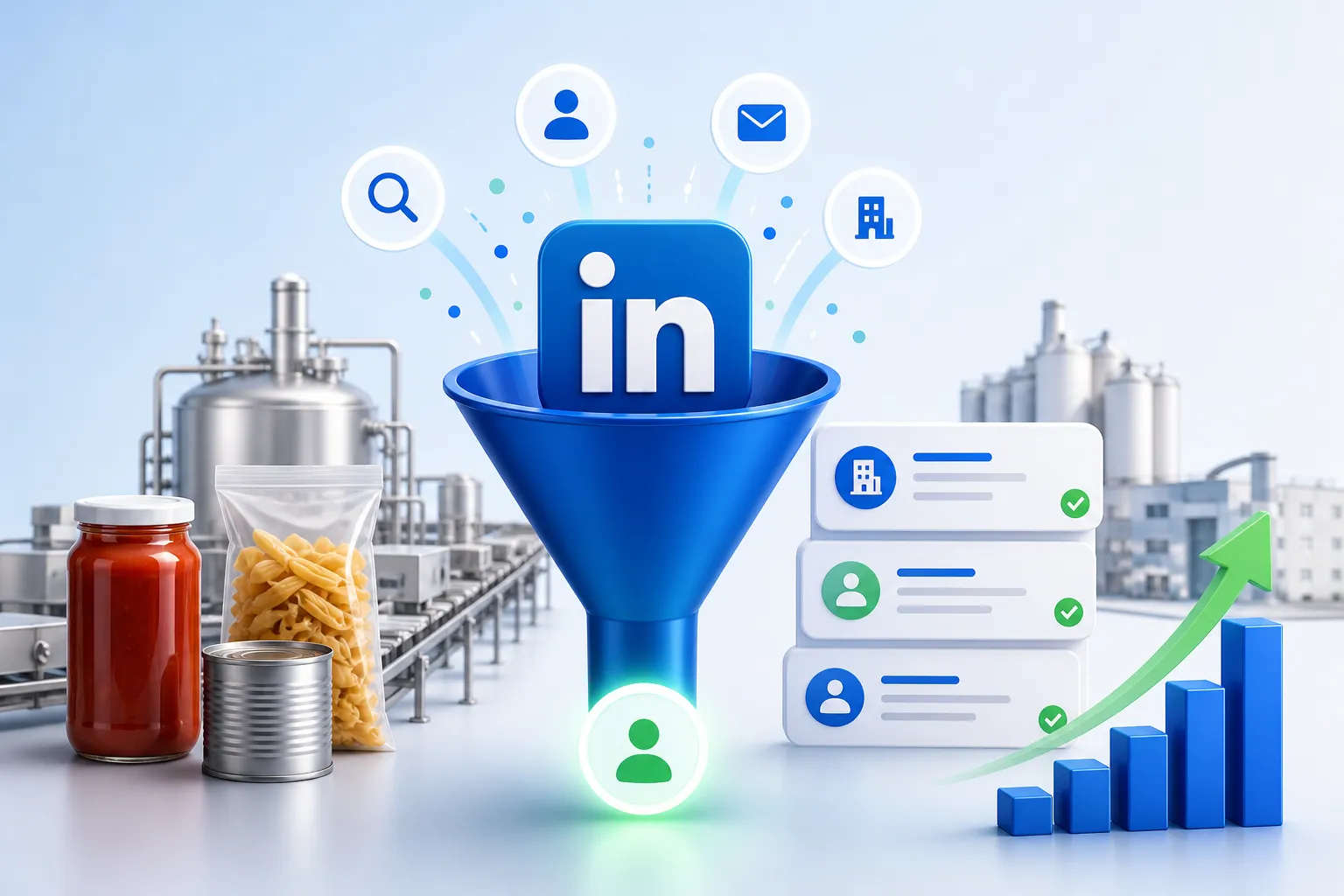
To find highly qualified food manufacturing leads, LinkedIn prospecting must be treated as a targeted, research-led process rather than a high-volume connection campaign. The core promise of this guide is to help food manufacturing suppliers identify better-fit accounts, accurately map complex buying groups, uncover relevant operational triggers, and create highly credible outreach.
This workflow is designed for intermediate-level supplier sales and marketing professionals targeting operations, procurement, plant management, engineering, quality, maintenance, and supply-chain personas. We will cover a structured, six-step process:
1. Define the ideal food manufacturing account.
2. Segment manufacturers and facilities.
3. Map multiple stakeholders.
4. Research operational triggers.
5. Personalize LinkedIn outreach.
6. Qualify and follow up.
Unlike broad B2B targeting methods, ScaliQ emphasizes a niche-focused angle centered on deep manufacturer segmentation and operational context. By mastering food industry B2B prospecting, you can transform your approach to LinkedIn prospecting for manufacturers, ensuring every message you send is backed by facility-level relevance and clear business value.
Why Generic LinkedIn Prospecting Fails for Food Manufacturing Suppliers
The term “food manufacturing” is simply too broad to function as a useful targeting category. A dairy processing plant, an industrial bakery, and a meat packaging facility all fall under this umbrella, yet they operate in entirely different realities.
Different manufacturer types have drastically different equipment environments. Their production volumes, facility footprints, and utility requirements vary wildly. Furthermore, they face distinct packaging, ingredient, sanitation, and traceability requirements, which in turn dictate entirely different procurement structures and buying timelines.
Generic prospecting often targets corporate-level contacts while ignoring the plant-level stakeholders who actually experience operational friction. Corporate procurement may control supplier frameworks and finalize vendor contracts, but plant managers are the ones identifying immediate operational needs on the floor. Engineering and maintenance leaders heavily influence technical specifications, while quality and food-safety teams dictate the stringent approval processes required to bring a new supplier on board.
Relying on generic executive targeting means you miss the very people who identify problems, evaluate suppliers, or influence specifications. This lack of manufacturer segmentation predictably leads to poor outcomes: irrelevant messages, low reply rates, wasted research time, and weak qualification.
While broad sales databases and generic LinkedIn prospecting advice encourage high-volume outreach, they fail to provide the facility-level context required to generate viable food processing company leads. Engaging food industry decision makers requires understanding their specific production realities, not just their corporate industry tags.
Build a Food Manufacturing Ideal Customer Profile Before Searching LinkedIn
An effective ideal customer profile (ICP) must describe the physical facility and its operating context, not just the company’s broad industry label. To identify viable food and beverage manufacturing prospects, you must define specific account-level criteria before initiating any outreach.
Begin by defining the manufacturer segment: determine if your ideal target is a bakery, dairy, beverage, meat and poultry, prepared foods, ingredients, snacks, packaging-intensive operation, or a contract manufacturing facility. Next, outline the production profile, including the facility type, product category, production scale, capacity indicators, and manufacturing complexity.
Geography is equally critical; document target regions, plant locations, service coverage areas, and logistics considerations. Assess the operational fit to determine the likely relevance to your equipment, service, ingredients, packaging, automation, sanitation, or logistics offerings. Finally, evaluate the commercial fit by looking at company size, buying structure, supplier requirements, and the likely purchasing scope.
To streamline this, create a simple “must fit / useful fit / disqualifier” framework. This helps distinguish an active manufacturing facility from a corporate-only listing, an inactive company page, or a distributor that does not operate relevant plants.
To systematically track food manufacturing companies by segment, use an account-research worksheet with the following fields:
• Company and facility name
• Segment and product category
• Plant location
• Facility or production evidence
• Relevant operational priorities
• Potential buying group
• Trigger event
• Verification status
• Next action
For teams seeking structured manufacturer segmentation and account research, ScaliQ provides specialized intelligence to identify right-fit food manufacturing suppliers efficiently.
Segment Manufacturers by Plant Type, Product Category, and Operational Need
Turning broad categories into actionable prospecting groups requires building separate messaging and search logic for distinct segments like bakery, dairy, beverage, meat and poultry, prepared foods, ingredients, snacks, and packaging-intensive operations.
Connect each segment to highly specific business outcomes. For example, a meat processor may prioritize sanitation and waste reduction, while a high-volume bakery focuses on throughput and labor efficiency. Food processing leads respond to relevance; avoid the trap of claiming that every company within a segment shares the exact same operational need. Precise B2B lead generation for food manufacturers relies on aligning your solution with the specific realities of food manufacturing segments.
Prioritize Accounts Using Evidence, Not Company Size Alone
Account priority should reflect true fit, evidence of operational need, timing, and access to relevant stakeholders—not just employee headcount or revenue.
Implement a simple prioritization score based on segment fit, facility relevance, operational triggers, persona coverage, and geographic or service fit. This scoring model is a practical framework for industrial sales prospecting, ensuring your team focuses its energy on qualified food manufacturing leads rather than chasing oversized accounts that lack immediate relevance. Effective food manufacturing account targeting means prioritizing the prospects most likely to benefit from your solution right now.
Map the Food Manufacturing Buying Committee on LinkedIn
Complex supplier purchases rarely involve a single, universal “decision-maker.” Instead, they require consensus across multiple stakeholders who evaluate the investment from different operational angles. To succeed, you should map at least two or three relevant contacts per qualified account where possible. Organizing these personas by role clarifies their likely contribution to the buying process.
Plant and Operations Personas
Plant managers, operations leaders, manufacturing managers, and production leaders are heavily invested in the daily realities of the facility. These roles provide critical insight into throughput, uptime, labor efficiency, bottlenecks, production continuity, and facility priorities. When conducting plant manager prospecting, outreach should always start with a specific operational issue or efficiency goal rather than a generic product catalogue. Earning the attention of food manufacturing operations relies on proving you understand their floor-level challenges. Plant manager lead generation is most effective when focused on measurable production outcomes.
Procurement and Supply-Chain Personas
Procurement managers, strategic sourcing leaders, purchasing leaders, and supply-chain directors evaluate suppliers through a commercial and logistical lens. These stakeholders focus on cost, supplier reliability, lead times, standardization, risk mitigation, and sourcing continuity. You must differentiate your messaging here; corporate procurement messaging should emphasize commercial stability, which is distinctly different from plant-level operational messaging. Targeting procurement manager leads requires demonstrating how you de-risk the supply chain. Relevant food manufacturing procurement contacts and food supply chain contacts prioritize vendors who ensure seamless operations without budget overruns.
Engineering, Maintenance, Quality, and Technical Influencers
Engineering managers, maintenance leaders, quality managers, food-safety stakeholders, and technical decision-makers are vital technical influencers. They evaluate specifications, integration requirements, sanitation standards, compliance, reliability, and ultimate supplier approval. Even when these technical influencers do not own the final budget, they hold the power to veto a solution that fails to meet facility standards.
Building relationships with these food manufacturing decision-makers is critical. In fact, peer-reviewed research on weak ties demonstrates how professional relationships and broader stakeholder networks can create highly useful access points within an organization. Job titles only indicate potential relevance; always verify a contact’s scope, facility connection, and actual buying influence before initiating outreach to manufacturing engineering prospects or conducting quality manager prospecting.
Use LinkedIn Signals to Find Food Manufacturing Accounts With Timing
There is a massive difference between a static lead list and an account demonstrating a current, observable reason for outreach. To elevate your manufacturer account research, you must identify LinkedIn signals that indicate potential timing and relevance.
Key prospecting signals include:
• Plant expansions or facility investments.
• New product launches.
• Hiring activity for operations, engineering, maintenance, quality, or supply-chain roles.
• Certifications or changes related to food safety and quality.
• Capital projects and automation initiatives.
• Leadership changes.
• Private-label growth, nearshoring, or new production activity.
• Company posts discussing capacity, production, sourcing, or operational priorities.
When you spot these food manufacturing prospecting signals, connect them to a plausible supplier relevance without aggressively assuming a purchase is imminent. A hiring post is a research signal, not absolute proof a company is buying.
To maintain organized LinkedIn outreach for food manufacturers, record the signal source, the date observed, the relevant facility, the potential business implication, the contact most likely to understand it, and a specific follow-up question.
Always validate these LinkedIn signals by cross-referencing company pages, individual profiles, and corporate websites. While AI-assisted enrichment can vastly accelerate your research, human review remains essential to ensure plant-level accuracy and message credibility. For more insights on structured research and account prioritization, explore the ScaliQ blog.
Write LinkedIn Outreach That Connects Supplier Value to Plant Outcomes
Generic messages like “I help food manufacturers improve efficiency” lack credibility and will be ignored by busy professionals. Effective LinkedIn outreach for food manufacturers must directly connect your capabilities to their specific plant outcomes.
Intermediate users should adopt this structured message framework:
1. Relevant observation: Note a specific account or facility signal.
2. Role-based context: Acknowledge their specific operational focus.
3. Supplier capability: Briefly introduce your specific problem area.
4. Plausible outcome: Highlight a realistic manufacturing result.
5. Low-pressure question: End with a simple, conversational next step.
You must adapt the value proposition for each persona:
• Plant manager: Focus on uptime, throughput, labor efficiency, and production continuity.
• Operations leader: Highlight process performance, bottlenecks, consistency, and capacity.
• Procurement leader: Emphasize sourcing reliability, supplier performance, cost control, and lead times.
• Supply-chain leader: Discuss resilience, planning, availability, logistics, and risk.
• Engineering or maintenance leader: Detail integration, reliability, automation, and serviceability.
• Quality leader: Address traceability, food safety, consistency, documentation, and supplier approval.
Use one highly specific, account-based observation rather than excessive, unnatural personalization. A sample framework might look like this: "Hi [Name], I noticed [Company]’s recent expansion at the [Location] plant. Typically, operations leaders managing this kind of scale run into [Specific Bottleneck]. We help facilities like yours achieve [Plausible Outcome] through [Supplier Capability]. Are you currently evaluating new approaches to [Problem Area]?"
Evidence significantly improves trust in B2B LinkedIn outreach for industrial suppliers. Include relevant manufacturer experience, measurable outcomes (when substantiated), applicable certifications, or integration details. Supplier prospecting for food processors demands verified claims; never imply a prospect has a specific problem without evidence, and ensure all customer claims are fully verified before publication.
Adapt the Message for Plant-Level and Corporate Buyers
Plant contacts will respond to immediate operational relevance, while corporate procurement prioritizes consistency, commercial terms, supplier governance, and scalability.
Adjust your calls to action accordingly. For plant manager outreach, ask about a specific operational priority or their current floor process. For procurement manager outreach, inquire about their supplier evaluation criteria or category planning initiatives. To navigate the food manufacturing buying committee effectively, utilize multithreaded outreach—engaging multiple stakeholders simultaneously but with coordinated, role-specific messaging rather than sending identical notes to everyone.
Qualify Food Manufacturing Leads Before Moving Them to Sales Follow-Up
Treating a simple LinkedIn connection as an immediate sales opportunity is a fast way to burn a bridge. Implementing a strict qualification checklist prevents premature pitches and ensures industrial sales qualification standards are met.
Before handing a lead to sales, verify the following:
• Relevant manufacturing segment.
• Active facility or plant location.
• Production or operational fit.
• Contact’s role and buying influence.
• Current supplier or process (where known).
• Operational pain or improvement area.
• Timing, project stage, or trigger.
• Procurement and technical requirements.
• Geographic and service fit.
It is crucial to understand the difference between a relevant account (fits the ICP), a relevant contact (has the right role), an engaged contact (replied to outreach), and a truly qualified sales conversation (has verified need and timing).
Track quality metrics instead of mere connection volume. Measure the number of qualified accounts identified, accounts with multiple mapped stakeholders, relevant replies, discovery conversations, qualified meetings, and progression by manufacturer segment. This ensures a steady pipeline of qualified food manufacturing prospects.
When executing a CRM handoff, preserve the entire research context, including the operational trigger, the exact message sent, the stakeholder’s role, and the agreed next action. Integrating tools like RepliQ into your broader prospecting ecosystem can help streamline this workflow coordination and follow-up tracking, ensuring no food manufacturing lead qualification data is lost in transition.
Use a Compliance-Conscious, Relevance-First Follow-Up Workflow
A successful follow-up workflow relies on providing new, measured context rather than repeatedly sending “just checking in” messages.
A structured follow-up sequence should look like this:
1. Initial connection request or relevant observation.
2. Follow-up introducing a highly role-specific question.
3. A message offering useful operational context or an industry resource.
4. A final, low-pressure message that leaves the door open for future contact.
Compliance-conscious LinkedIn outreach must respect platform rules, applicable privacy obligations, and recipient preferences. Moving data between LinkedIn and commercial email channels creates additional compliance responsibilities. When transitioning to email, you must adhere to the FTC CAN-SPAM compliance guidance regarding truthful sender information, opt-outs, and unsubscribe handling. Furthermore, you must follow the ICO direct marketing guidance regarding lawful bases, transparency, data protection, and the right to object to direct marketing.
To maintain ethical B2B prospecting compliance, strictly avoid misleading sender identities, unverified claims, excessive automation, and the use of purchased or poorly verified contact data. Never send repeated messages after a prospect has provided a clear objection or opt-out. Respectful LinkedIn follow-up for manufacturers builds long-term trust.
When a Structured Prospecting Workflow Is Better Than Manual Research Alone
Food manufacturing account-based prospecting generally falls into three approaches: manual LinkedIn and web research, broad data and sales-enablement platforms, and a structured, niche-focused manufacturer intelligence workflow.
Manual research remains highly valuable for reviewing nuanced plant-level context, validating a specific trigger, checking whether a contact is genuinely relevant, and writing the final, highly personalized message. However, manual research alone cannot scale effectively.
Structure and enrichment are essential for standardizing account fields, accurately segmenting manufacturers, mapping complex buying groups, prioritizing accounts systematically, and preserving critical research for CRM handoff.
This is where ScaliQ differentiates itself from broad tools. By emphasizing food-manufacturing specificity, deep plant and supply-chain context, precise manufacturer segmentation, and human-reviewed relevance, it bridges the gap between raw data and actionable AI-assisted prospect research. For suppliers needing a repeatable, segmented approach, structured manufacturer intelligence far outperforms generic database scale or automation-first outreach.
Conclusion: Turn LinkedIn Research Into Qualified Food Manufacturing Opportunities
Transforming raw data into qualified food manufacturing leads requires a disciplined, research-first approach. By defining your ideal manufacturer, segmenting by precise plant and product context, mapping the entire buying committee, and identifying credible triggers, you set the stage for success. Personalizing your outreach around measurable operational outcomes and qualifying rigorously before CRM handoff ensures that your sales team focuses only on viable opportunities.
The goal of food industry B2B prospecting is never maximum connection volume; it is securing better-fit accounts and hosting more relevant conversations. Remember that plant, operations, procurement, engineering, quality, and supply-chain stakeholders all contribute to a complex supplier decision.
For suppliers who need precise manufacturer segmentation and reliable account research, ScaliQ serves as a practical, industrial-focused resource to elevate your LinkedIn outreach. Explore ScaliQ to refine your targeting and turn operational insights into sustainable revenue.