

LinkedIn Outreach for B2B Market Research Firms
Effective LinkedIn outreach for B2B market research firms depends entirely on identifying research-ready accounts—not simply collecting contacts by job title or company size. Broad targeting and generic, capability-led messages often create low-relevance conversations that waste time and yield poor conversion rates. To succeed, research agencies must pivot toward a highly targeted approach.
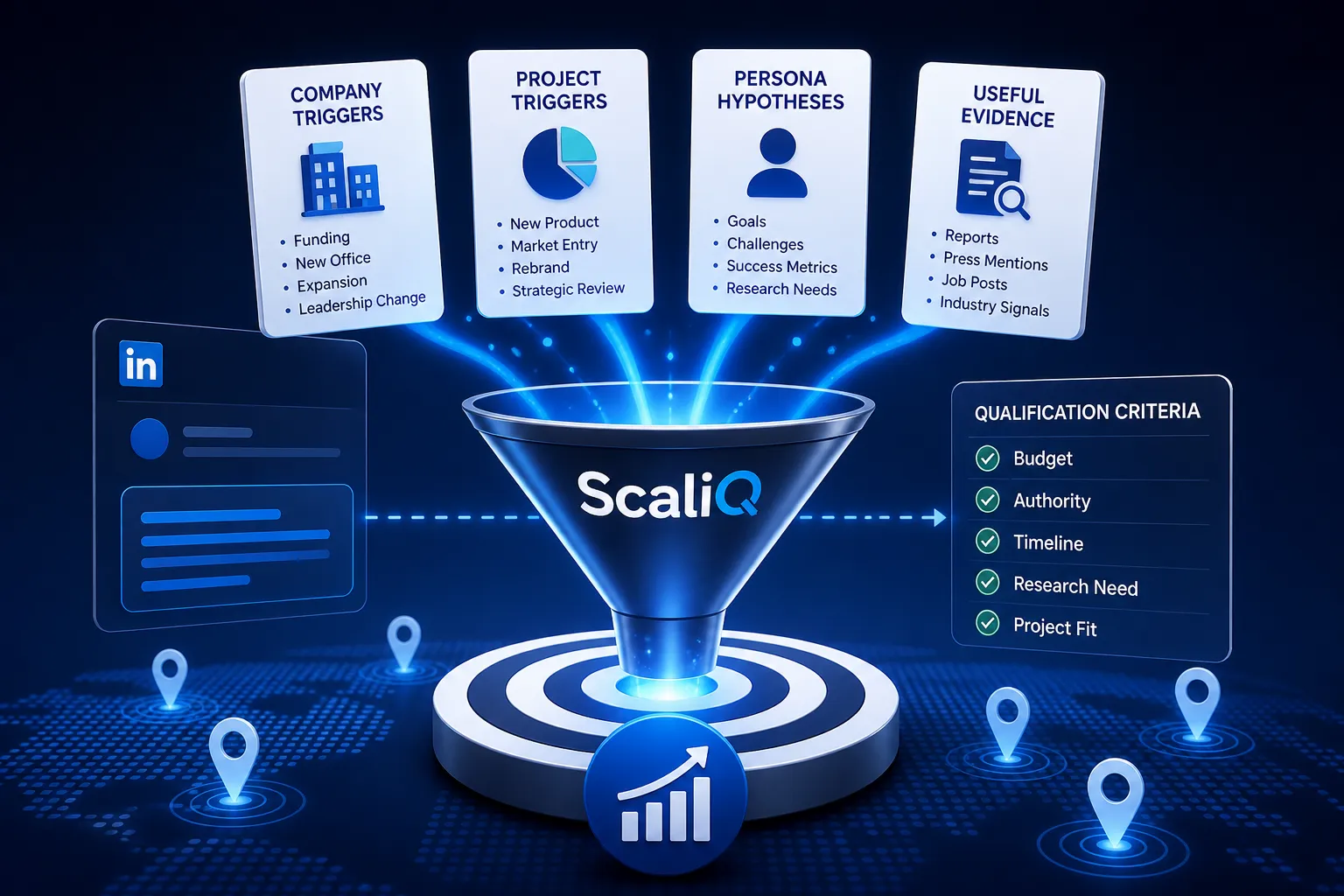
This article introduces a unique, trigger-based system that combines company characteristics, project signals, buyer personas, useful evidence, and strict qualification criteria. Designed specifically for boutique research consultancies and B2B market research firms managing business development or client acquisition, this framework moves beyond surface-level networking.
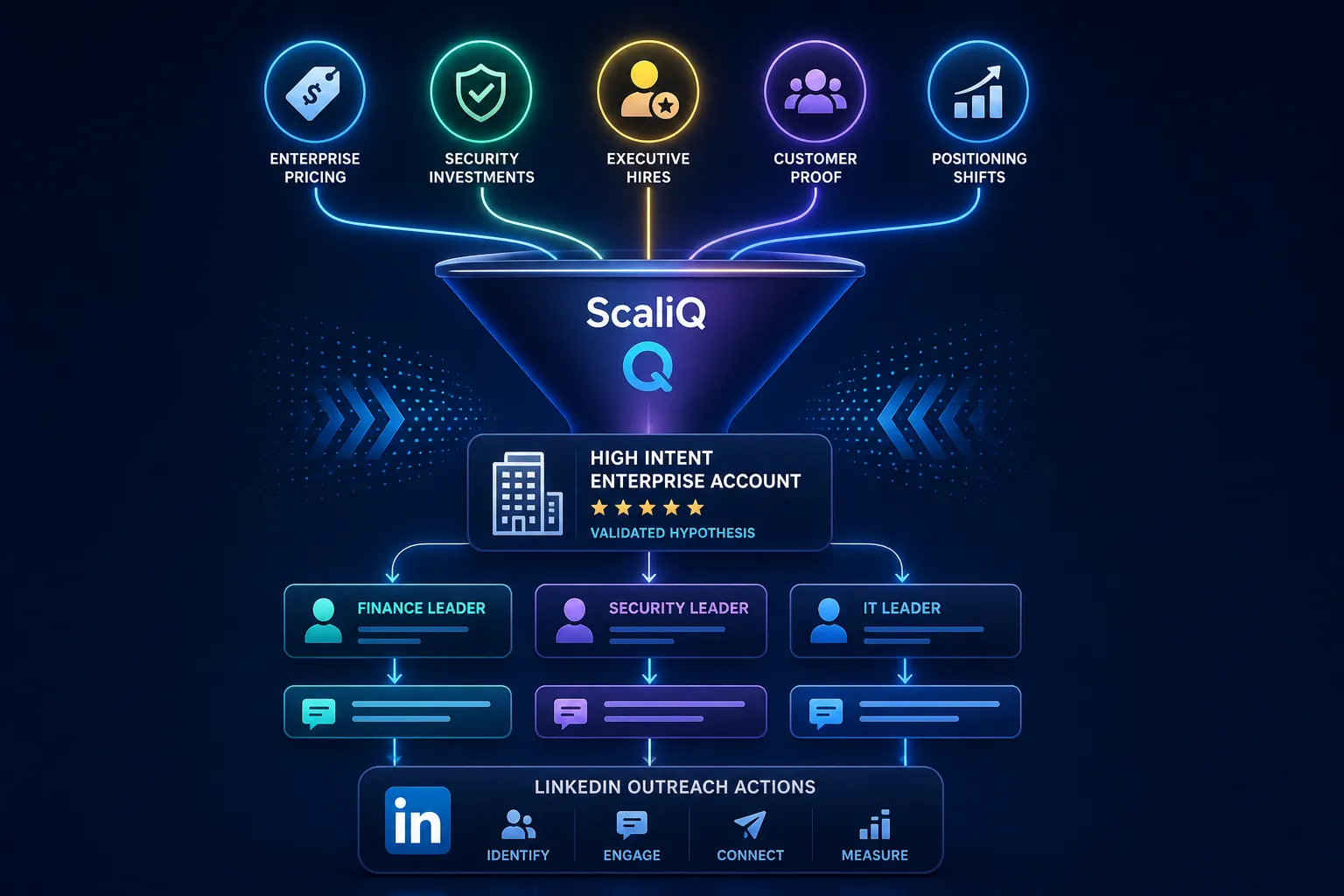
By implementing this process, you will learn how to identify likely triggers, map the buying committee, create an insight-led sequence, qualify conversations, and measure pipeline quality. The following strategies provide practical, implementable steps for research agency prospecting while acknowledging the complexities of research methodology, buyer dynamics, and platform compliance. ScaliQ provides the intelligence layer that helps identify companies and projects whose characteristics may indicate a timely need for market research, ensuring your outreach is driven by relevance rather than volume.
Define an Ideal Research Prospect Using Company and Project Signals
A research agency’s ideal client profile must go beyond basic demographics like industry, company size, and job title. Traditional B2B audience targeting often fails because it assumes that everyone with a specific title is currently in the market for research. Instead, account-based prospecting requires analyzing specific indicators.
It is crucial to understand the difference between company characteristics and project characteristics:
• Company characteristics: These include the target market, growth stage, business model, geographic expansion plans, organizational changes, and overarching strategic priorities.
• Project characteristics: These are specific, time-bound initiatives such as product launches, market-entry initiatives, brand repositioning, acquisitions, funding events, new category creation, and strategic planning cycles.
Each of these characteristics can suggest a possible research question without assuming that a project is already funded or active. For instance, a geographic expansion signals a potential need for market sizing, while a recent acquisition might indicate a need for brand perception studies.
Prospect selection must be connected to a specific research hypothesis: “This company may need evidence to support a specific business decision.” When generating market research leads, document the target account, the observed signal, the possible research need, the source of your evidence, the likely stakeholder, and your confidence level in the data. Remember that these signals are indicators for prioritization, not absolute proof of intent. Always encourage human verification before initiating outreach.
Build a Research-Readiness Trigger Framework
To systematically identify research-ready accounts, create a framework that maps observable triggers to likely research needs:
• Product launch: Indicates a need for customer validation, segmentation, or positioning research.
• Market entry: Suggests requirements for market sizing, buyer understanding, or competitive intelligence.
• Repositioning: Points toward brand perception, messaging, or audience research.
• Funding or acquisition: Highlights a need for strategic diligence, category analysis, or growth planning.
• New executive mandate: Creates demand for baseline research, customer understanding, or performance measurement.
• New category or visible customer uncertainty: Requires exploratory or qualitative research.
Rank these B2B research project triggers by relevance, recency, evidence quality, and fit with your agency’s specific capabilities. However, exercise caution: do not treat public announcements as definitive proof that a prospect is ready to buy. According to the National Library of Medicine, digital behavior signals can inform engagement, but observable signals must be interpreted carefully, ethically, and verified by human review to support successful market research business development.
Use an Account Research Worksheet Before Contacting a Prospect
Before launching your LinkedIn prospecting efforts, use an account research worksheet to structure your approach. Your worksheet should include fields for:
• Target account and relevant business context
• Trigger or project signal
• Potential business decision
• Possible research question
• Relevant stakeholder or buying-center role
• Supporting evidence
• Personalization idea
• Qualification hypothesis
Separating verified facts from assumptions is vital. This worksheet prevents superficial personalization—such as merely repeating a prospect’s job title or referencing a recent post without adding genuine business relevance. To streamline this process, ScaliQ serves as a powerful resource for identifying relevant company and project characteristics when building a highly targeted research prospect list for account-based marketing for research firms.
Match Outreach to Marketing, Strategy, Product, and Insights Buyers
A research buying decision rarely rests on one person's shoulders; it typically involves multiple stakeholders with vastly different priorities and definitions of value. Sending a single, generic message to every senior contact will severely limit your success.
When finding insights managers on LinkedIn or engaging other leaders, you must map each persona to their likely business priority, a possible research question, a useful evidence or content asset, and an appropriate call to action. It is highly recommended to identify multiple stakeholders within a target account rather than relying on a single contact. Understanding B2B buying-center roles and mapping the broader B2B decision-making unit—including users, influencers, buyers, deciders, and gatekeepers—ensures your message resonates with the right research buyers.
Marketing Leaders
Marketing leaders prioritize customer understanding, segmentation, positioning, campaign relevance, and brand perception. When generating marketing research leads, build your message around a possible decision, such as entering a new category, repositioning the brand, or improving audience understanding. Lead with a specific observation or a diagnostic question rather than a laundry list of research services. Use a low-friction call to action (CTA), such as asking whether the observed business question is currently on the team’s agenda, to initiate market research sales outreach centered on customer research.
Strategy Leaders
Strategy leaders focus on market sizing research, competitive intelligence, market entry, portfolio decisions, and strategic planning. Connect your outreach hypothesis to a visible area of uncertainty that may affect a high-level business decision. Demonstrate strategic relevance without presenting an unsupported estimate or pretending to possess insider knowledge of the company’s internal priorities. Instead of requesting a full sales meeting immediately, offer a short diagnostic conversation or a relevant evidence asset.
Product Leaders
Product leaders are deeply invested in product discovery research, customer needs, concept validation, feature prioritization, and overcoming adoption barriers. Tie your message to a visible product or category signal wherever available. Show how qualitative research leads or quantitative data could reduce uncertainty at a specific stage of their product development lifecycle. Avoid presenting research as a generic add-on; frame it strictly as vital support for a concrete product decision.
Insights and Research Leaders
Insights leaders care about research rigor, methodological fit, evidence quality, sample design, stakeholder usefulness, and delivery confidence. When engaging quantitative research leads, use more detailed language about research design and decision usefulness than you would with marketing or product personas. Highlight transparent methodology and collaboration rather than simply claiming expertise. Explain how your external agency can complement—not automatically replace—an internal insights team. Aligning your market research agency sales strategy with ISO 20252 research standards when discussing consistent research processes, terminology, and quality expectations builds immediate credibility.
Build an Insight-Led LinkedIn Outreach Sequence
A successful LinkedIn outreach sequence must be practical, permission-based, and designed to move a prospect from a relevant observation to qualification without relying on high-volume, generic spam.
The difference between capability-led and insight-led messaging is stark:
• Capability-led messaging: “We provide market research services.” (Easily ignored).
• Insight-led messaging: “A visible business change may create a specific evidence gap—does this question sit with your team?” (Invites dialogue).
Tailor your sequence to the account priority, trigger strength, stakeholder role, and any existing relationship. Adapt timing and message intervals to the prospect’s response and preferences. Remember to use transparent methodology and human review for AI-assisted personalization; automation cannot reliably infer a prospect’s needs without human verification.
Step 1 — Connection Request or Initial Contact
Keep the LinkedIn connection request relevant to the person’s role or the account’s observable business context. Refer to a genuine signal only when it can be verified. Avoid attaching a full service menu, sending a long pitch, or making unsupported claims about their company. Use a permission-based tone that gives the recipient an easy way to decline. Utilizing proper research agency outreach templates ensures your LinkedIn prospecting remains professional and targeted.
Step 2 — Value-Add Follow-Up
In your follow-up, share one useful asset, observation, diagnostic question, or relevant research perspective. Explain exactly why this information matters to the recipient’s current business decision. Keep the evidence focused; do not give away a full proposal or pretend to have completed research that was not actually conducted. This insight-led outreach is a cornerstone of B2B lead generation and market research content marketing. When providing educational evidence or a practical research-prospecting framework, link to a relevant resource on the ScaliQ Blog to support the conversation genuinely.
Step 3 — Hypothesis Test
Ask a focused question to determine whether your assumed research hypothesis is relevant. Use branching responses:
• If the prospect confirms the issue, explore scope and timing.
• If the prospect is unsure, offer a concise diagnostic resource.
• If the prospect says the issue is not a priority, acknowledge the response professionally and avoid repeated pressure.
The goal of LinkedIn social selling for research buyers is to test relevance, not to force a meeting.
Step 4 — Low-Friction Meeting Invitation
Invite the prospect to a short diagnostic conversation only after relevance has been firmly established. State clearly what the conversation will help clarify: the research question, evidence gap, audience, timing, or next steps. Offer an alternative, such as sending a checklist or continuing the discussion asynchronously. Educate the prospect on how to distinguish this useful consultation from a premature capabilities presentation, ensuring market research sales outreach leads to genuinely qualified research conversations.
Step 5 — Follow-Up and Branching Logic
Your LinkedIn follow-up sequence must include branching logic for various scenarios: no response, a positive but vague response, an active research need, a referral to another stakeholder, or a “not now” response. Document the reason for follow-up and the next agreed action. Avoid excessive repetition, false urgency, or messages that create pressure, as these damage research agency prospecting efforts. For managing response workflows and adjacent prospecting operations efficiently, tools like RepliQ can support structured follow-up execution.
Qualify Leads and Measure Pipeline Quality
To succeed in B2B lead generation, research firms must replace surface-level LinkedIn metrics with a qualification and measurement model tied directly to actual research opportunities. Connection acceptance, profile views, and reply volume do not necessarily indicate research readiness.
Instead, measure the quality and progression of conversations alongside activity metrics. A qualified market research lead is defined as an account with relevant fit, a plausible research need, an identifiable stakeholder, and a credible next step.
Create a Research-Lead Qualification Scorecard
Build a simple research lead scoring scorecard using the following criteria to identify a research-ready prospect:
• Account fit: Does the organization resemble the agency’s ideal client?
• Trigger strength: Is there a relevant and verifiable business change?
• Problem clarity: Can the likely research question be clearly articulated?
• Stakeholder access: Is the contact involved in influencing or deciding on research?
• Urgency: Is there an apparent decision timeline?
• Budget or funding evidence: Is there any reliable indication of resources, without making assumptions?
• Next-step commitment: Has the prospect agreed to a meaningful action?
Record evidence for each score rather than assigning points based on intuition. This scorecard helps prioritize human follow-up and prevents wasting time on low-fit accounts during account-based marketing for research firms.
Track Metrics That Reflect Commercial Quality
Organize your LinkedIn outreach metrics into four distinct levels:
• Activity: Connection requests, messages sent, and content interactions.
• Engagement: Replies, meaningful exchanges, and content responses.
• Qualification: Qualified conversations, confirmed research problems, and stakeholder referrals.
• Pipeline: Opportunities created, opportunity rate, commissioned work, conversion quality, and pipeline contribution.
Segment these metrics by persona, trigger type, account tier, and message angle to accurately gauge research pipeline measurement. Focus on tracking progression rather than promising specific benchmark conversion rates.
Improve the Process Through Review
Schedule regular reviews to optimize your LinkedIn prospecting strategy and market research client acquisition. Evaluate:
• Which triggers produced the most relevant conversations.
• Which hypotheses were inaccurate.
• Which personas responded best to specific evidence assets.
• Where prospects exited the sequence.
• Which conversations successfully progressed to a defined next step.
Use human review to continuously improve personalization rules and remove misleading assumptions. Turn recurring objections into content, FAQs, or sales enablement resources. Throughout this outreach optimization, strictly adhere to the Insights Association’s market research ethics standards regarding responsible data use, professional conduct, participant privacy, and transparent communication.
Use Content and Intelligence to Strengthen Account-Based Prospecting
Content is a powerful tool to warm priority accounts, support outreach credibility, and create a repeatable system for account-based marketing for research firms. Research firms must connect thought leadership directly to a sales process instead of publishing disconnected educational content.
Build content around specific buyer questions:
• How to identify research-ready accounts.
• How to choose between qualitative and quantitative research.
• How to qualify a research project.
• How to avoid generic agency outreach.
• How to evaluate evidence and methodology.
One strong framework can be repurposed into LinkedIn posts, short videos, email follow-ups, sales collateral, and website checklists, driving LinkedIn lead generation for market research companies and supporting research agency prospecting.
Create Evidence Assets for Each Persona
Develop practical research buyer content and evidence assets, such as:
• A research-readiness trigger checklist.
• A buyer-role mapping worksheet.
• A market-entry research diagnostic.
• A product discovery question set.
• A research project qualification scorecard.
Match each asset to a relevant business question and stakeholder. Use anonymized or clearly sourced observations to support your market research content marketing, ensuring you never imply access to confidential company information during B2B research lead generation.
Connect Content Engagement to Outreach Carefully
Use content interaction as a valid reason to begin a relevant conversation, but not as definitive proof of purchase intent. Reference a prospect’s stated interest only when it is visible and appropriate to use. Coordinate your content-led prospecting with account priorities while avoiding repetitive or intrusive targeting. When executed correctly, content provides prospects with a lower-friction path to engage before committing to a formal consultation, enhancing your LinkedIn social selling and B2B audience targeting.
Differentiate ScaliQ’s Approach From Generic Prospecting Tools
Signal-based prospecting for research firms requires more than just scraping emails. This research-specific system contrasts sharply with broad lead-generation platforms and automation-centered workflows. ScaliQ addresses critical gaps by focusing on:
• Company and project signals instead of job-title targeting alone.
• Persona-specific hypotheses instead of one message for every buyer.
• Evidence-led relevance instead of volume-first automation.
• Research-readiness qualification instead of meeting counts alone.
• Human review and compliance instead of unchecked personalization.
ScaliQ acts as an intelligence layer that supports account selection, prioritization, and message relevance for AI-assisted market research prospecting. All workflows must emphasize legal, compliant data use and align with LinkedIn platform rules and privacy regulations.
Practical Checklist for Launching a Research-Focused LinkedIn Program
To execute this framework effectively, use this LinkedIn outreach checklist for research agency prospecting and market research lead qualification:
• Define the ideal research prospect.
• List relevant company and project triggers.
• Select priority accounts.
• Identify marketing, strategy, product, and insights stakeholders.
• Document a research hypothesis for each account.
• Prepare one useful evidence asset.
• Draft a permission-based sequence.
• Establish qualification criteria.
• Set pipeline-quality metrics.
• Review privacy, ethics, and platform compliance.
Before sending, review:
• Is the trigger verified?
• Is the message relevant to the recipient’s role?
• Is the hypothesis clearly framed as a question rather than a claim?
• Is the CTA proportionate and low friction?
• Can the agency support the proposed next step with credible methodology?
Maintaining alignment with ISO and Insights Association standards ensures transparent research practices and ethical engagement at every touchpoint.
Conclusion: Turn LinkedIn Activity Into Qualified Research Conversations
Effective LinkedIn outreach for B2B market research firms requires shifting focus from maximum outreach volume to better relevance, clearer hypotheses, and more useful conversations. This trigger-based system enables research agency prospecting by defining prospects through company and project signals, matching messaging to stakeholder priorities, and utilizing an insight-led, permission-based sequence.
By qualifying conversations with explicit criteria and measuring pipeline quality, you can transform generic networking into a reliable source of market research leads. Begin with a small set of target accounts, document your learnings, and refine your approach before scaling the workflow.
To explore how company and project intelligence can support your research prospecting and drive highly qualified conversations, discover more through ScaliQ. ScaliQ is built on transparent methodology, human review, deep research-industry understanding, and the responsible, compliant use of AI-assisted intelligence.