

How to Use New Certifications as a LinkedIn Prospecting Trigger
For B2B sales and revenue operations teams, discovering the right time to engage a target account is just as critical as identifying the right stakeholder. While many sellers rely on generic intent data, company certifications serve as highly specific, timely company-level signals that can reveal changes in compliance investment, operational maturity, market expansion, or enterprise readiness.
However, leveraging these certification sales triggers effectively requires more than a simple alert. Certification information is often scattered across company websites, press announcements, hiring pages, certification-body records, and LinkedIn. More importantly, a certification is not automatic proof of purchase intent. It becomes a valuable piece of company certification signals when connected to account fit, business context, relevant stakeholders, and supporting data.
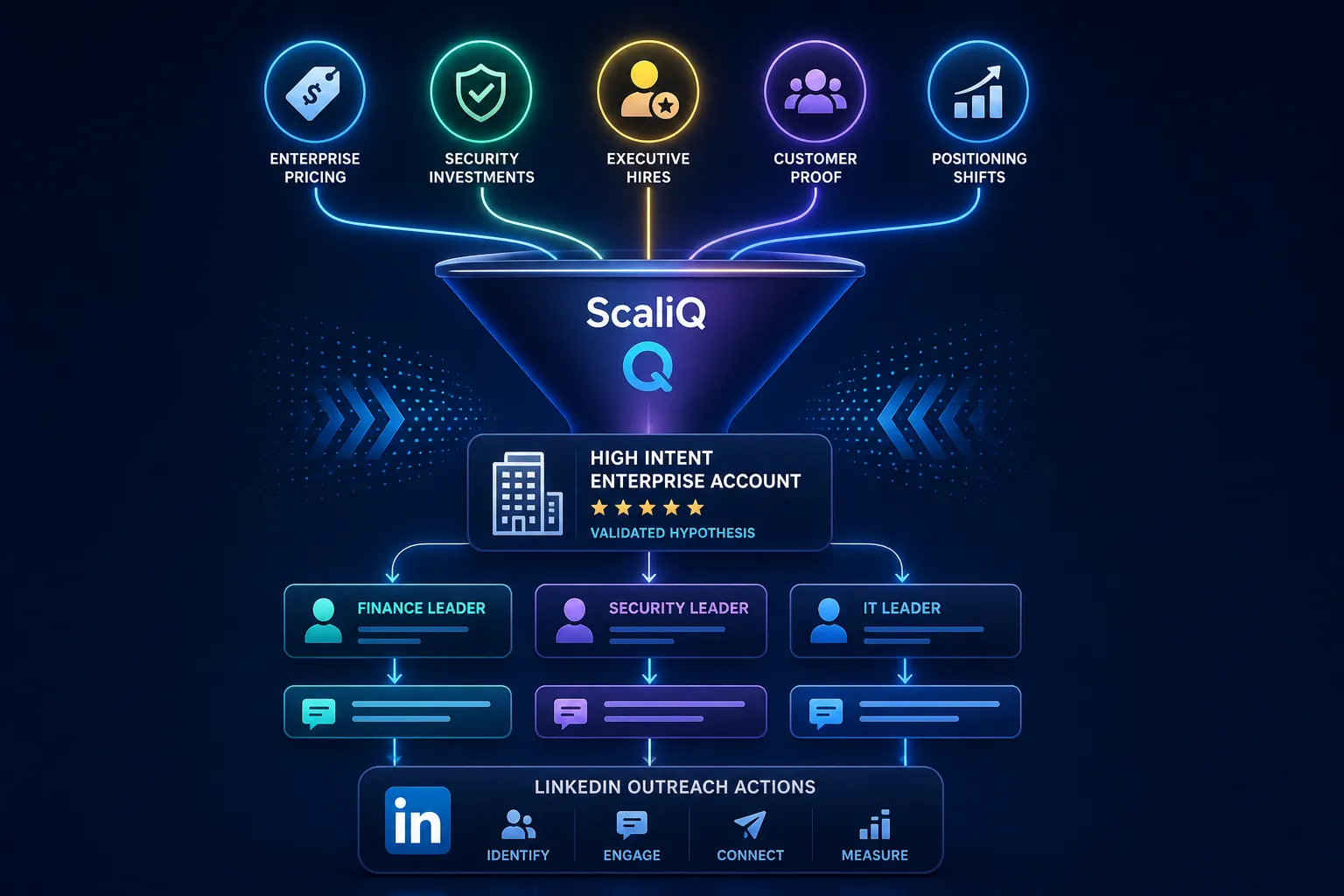
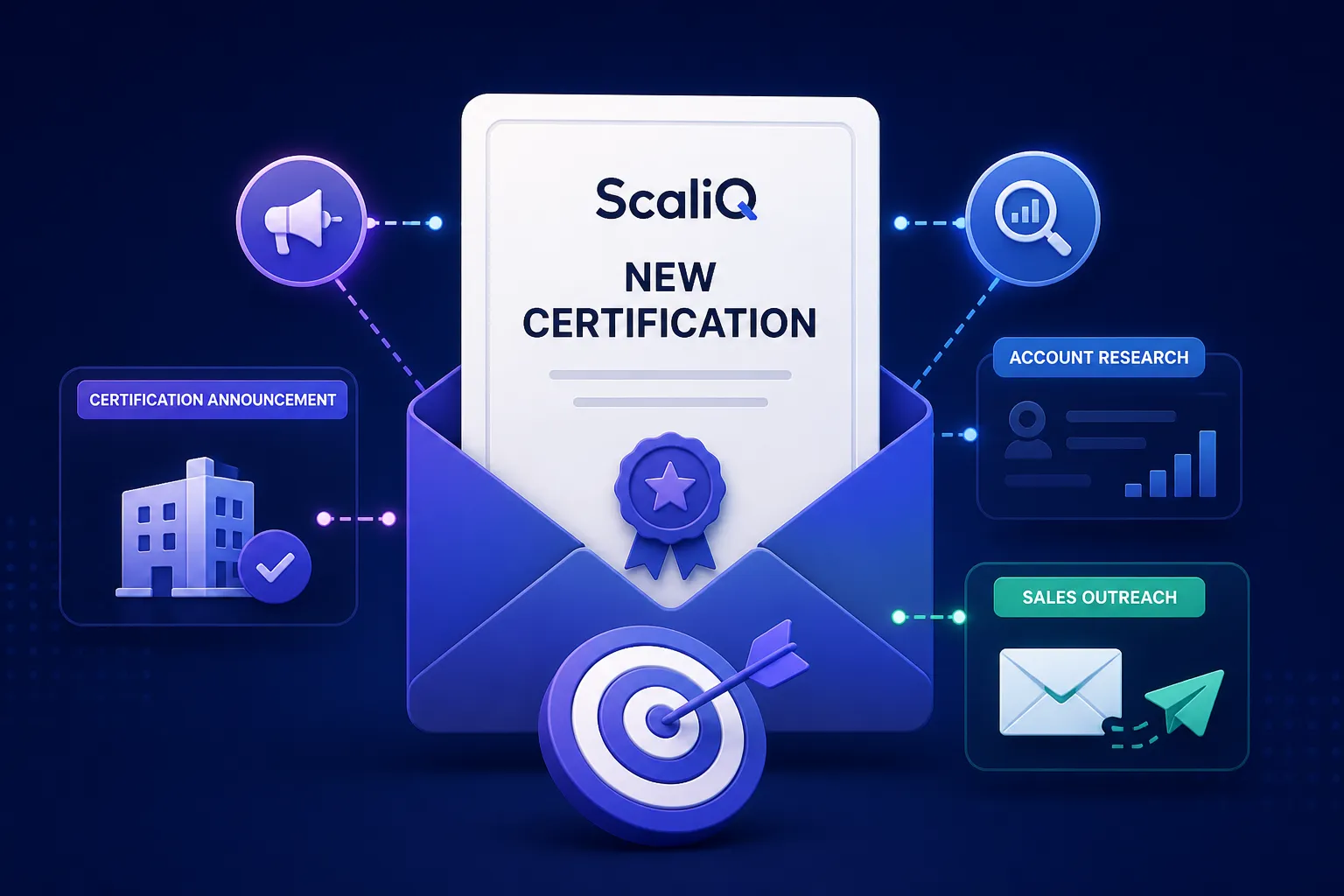
The ideal workflow requires you to detect the certification, verify the evidence, interpret the likely business change, identify the right stakeholders, and personalize your outreach. By adopting a research-focused approach like ScaliQ, revenue teams can transform public business events into structured, verified account intelligence rather than relying on unsupported buying-intent assumptions for their LinkedIn prospecting.
What Is a Certification Sales Trigger?
A certification sales trigger is a verifiable public milestone indicating that a company has achieved a specific operational, security, or compliance standard. When a newly certified company earns these credentials, it often signals significant internal investment. These credentials can highlight a focus on security and privacy controls, quality management, compliance readiness, enterprise procurement requirements, or expansion into regulated industries and new geographies.
To use these compliance certifications effectively as B2B buying signals, you must understand the distinctions between different credentials:
• Certification: A formal credential awarded by an independent third party verifying that standards have been met. For foundational context, review this authoritative ISO certification resource.
• Accreditation: Formal recognition by an authoritative body that an organization is competent to perform specific processes.
• Attestation: A specialized report (like SOC 2) where an auditor assesses internal controls.
• Registration: The inclusion of a company on an official list, often related to quality standards.
• General compliance claim: A self-reported statement of adherence to a regulation, lacking third-party verification.
The date, scope, issuing organization, geography, and stated business purpose of the credential matter immensely. Ultimately, remember this core principle: a certification is a context signal first and a prospecting trigger second.
Why a New Certification Can Represent a Business Change
Certification activity rarely happens in a vacuum; it typically reflects a broader, strategic business initiative rather than an isolated administrative milestone. When tracking company certification signals, consider the underlying business changes driving the effort.
A new credential often means a company is preparing for enterprise procurement, expanding into regulated markets, formalizing internal processes for scale, supporting a new geography, or building trust during a complex sales cycle. These market expansion signals and operational maturity signals serve as powerful context for outreach. However, they are hypotheses requiring validation, not guaranteed facts to be blindly repeated in your messaging.
Certification Signal Versus Purchase Intent
It is crucial to distinguish between a sales trigger event and raw purchase intent. A completed certification may actually be retrospective, indicating a project that has just concluded rather than an immediate, active buying need.
To clarify this in your workflow, separate signals into three tiers:
• Discovery signal: The company recently announced or received a certification.
• Qualification signal: The certification aligns with your Ideal Customer Profile (ICP), target market, or solution category.
• Outreach signal: Supporting intent data and evidence suggest an active initiative or relevant stakeholder conversation.
Instead of binary "hot lead" classifications, use confidence labels (high, medium, low) to score a prospecting trigger before initiating outreach.
Which Certifications Can Reveal Prospecting Opportunities?
Building a practical taxonomy of company certification signals helps revenue teams translate credentials into potential business initiatives. This framework organizes newly certified companies by their likely business implications, helping you pinpoint the right certification sales triggers.
Security, Privacy, and Assurance Certifications
Certifications in this category relate to security program maturity, vendor-risk reviews, enterprise customer requirements, and data protection expectations. ISO 27001 and SOC 2 are prime examples, though they represent different forms of assurance. For authoritative background on SOC reports, refer to this AICPA SOC resource.
An ISO 27001 sales trigger or SOC 2 certification sales trigger points you toward specific stakeholders: security leaders, compliance directors, privacy professionals, technology executives, and procurement teams. The strongest security compliance prospecting trigger combines the credential with enterprise hiring, security-related job postings, procurement language updates, or a push into a new target market.
Quality, Process, and Operational Certifications
An ISO 9001 prospecting signal indicates formalized processes, operational scaling, quality-control investment, and preparation for larger customers or more demanding supply chains. These operational maturity signals map to stakeholders in quality assurance, operations, manufacturing, supply chain, and executive leadership.
When leveraging quality certification sales triggers, always validate whether the credential applies to the entire company, a single geographic site, a specific product line, or a particular business unit.
Industry, Payment, and Regulated-Market Signals
Credentials like PCI DSS or HIPAA-related compliance activity indicate expansion into a regulated customer segment, new data-handling requirements, increased scrutiny from enterprise buyers, or changes to vendor processes.
When evaluating these regulated market signals, precision is paramount. Avoid stating a company is "HIPAA certified" unless the source explicitly supports that exact wording. Instead, use accurate compliance certification prospecting language, such as "published HIPAA-related compliance information." A PCI DSS prospecting trigger is highly valuable, provided your terminology reflects the reality of the compliance claim.
How to Find Newly Certified Companies
Because certification information is decentralized, no single channel is sufficient for discovering newly certified companies. A repeatable company research process is essential for uncovering these LinkedIn prospecting opportunities.
Monitor Public Company and Professional Sources
To capture sales prospecting company news and company certification signals, systematically monitor:
• Company newsrooms and press releases.
• Dedicated certification or compliance pages.
• Certification-body records (where publicly available).
• LinkedIn company posts and updates.
• Executive and compliance-leader posts on LinkedIn.
• Job postings mentioning certification maintenance, auditing, or implementation.
• Website changes relating to security, procurement, or regulated-market positioning.
Always capture the original publication date and the date the certification was earned or renewed. Record whether the LinkedIn intent signals stem from a direct company statement, an independent public record, an employee post, or a secondary media mention.
Use LinkedIn to Identify the People Behind the Initiative
Once a signal is detected, use LinkedIn account-based selling techniques to identify the people driving the initiative. Search for professionals associated with security, compliance, quality assurance, operations, procurement, risk, legal, or revenue expansion.
Look for employees who announced, led, or referenced the certification project. It is important to distinguish between the person who earned an individual credential, the manager building a certified team, and the executive accountable for the company-level initiative. LinkedIn validates the business context; it should not be your only evidence source. For deeper context on stakeholder mapping, consult LinkedIn’s sales-solutions context.
Build a Certification-Signal Research Record
Structured records improve the handoff to sales and eliminate redundant manual research. When tracking sales trigger events, record the certification name, scope, business unit, date announced, source URL, geography, likely accountable stakeholder, and related hiring or expansion signals. Assign a confidence level to the CRM prospecting workflow to dictate prioritization. For related guidance on signal detection, company research, and certification signal scoring workflows, explore the ScaliQ blog.
How to Verify Whether a Certification Is a Strong Prospecting Signal
To prevent inaccurate personalization and separate meaningful triggers from weak or stale data, teams must verify the B2B buying signals before initiating outreach. Company research must prioritize evidence quality over trigger volume.
Apply the Five-Part Evidence Checklist
Before acting on a prospecting trigger, apply this certification verification checklist:
1. Recency: Is the announcement recent enough to support timely outreach?
2. Authenticity: Is the intent data published by the company, certification body, or another credible source?
3. Scope: Does it apply to the whole company, a site, product, team, or individual?
4. Relevance: Does it relate to the account’s industry, use case, or target market?
5. Commercial context: Are there supporting signals that indicate an active initiative?
Combine Certification With Adjacent Company Signals
A certification appearing in isolation is a weak signal. To strengthen your account-based selling approach, triangulate the certification with adjacent market expansion signals and B2B buying signals, such as:
• Security, compliance, quality, or operations hiring.
• Geographic expansion or funding announcements.
• Launching new products or entering new customer segments.
• Technology stack changes or leadership transitions.
• New procurement or enterprise-sales language on the website.
A certification plus one relevant supporting signal provides highly actionable context. This evidence-based workflow is vastly superior to broad intent platforms or manual scraper tools that surface activity without explaining the underlying business change. Supporting signals do not prove a purchase project, but they raise your confidence level.
Use a Practical Certification Trigger Score
Implement a certification signal scoring model based on recency, relevance, ICP fit, stakeholder visibility, hiring activity, evidence quality, and the number of involved teams. Categorize these sales trigger events into three prospecting prioritization actions:
• Monitor: Relevant but insufficient evidence.
• Research: Strong fit, requiring stakeholder or scope validation.
• Engage: Recent, verified, relevant, and supported by adjacent signals.
The LinkedIn Outreach Workflow After a Certification Event
Translating a verified trigger into personalized outreach requires a respectful, relevant, and low-pressure approach. Your LinkedIn prospecting message should acknowledge a public milestone without implying an unverified problem based on certification sales triggers.
Choose the Right Stakeholder
Map your stakeholders based on the specific certification type:
• Security/SOC initiatives: Security, compliance, privacy, IT, or vendor-risk leaders.
• Quality certifications: Quality, operations, supply-chain, or manufacturing leaders.
• Regulated-market activity: Legal, compliance, product, operations, or executive sponsors.
• Market expansion: Revenue, partnerships, operations, or regional leadership.
Use the public announcement and your LinkedIn account research to form a hypothesis about ownership. Contact the compliance leaders or managers closest to the initiative before defaulting to the most senior executive.
Use a Relevance-First LinkedIn Message Structure
A high-converting LinkedIn message after certification follows a four-part structure:
1. Reference the certification or public milestone accurately.
2. Connect it to a plausible business priority.
3. Ask an open question about the next operational or commercial step.
4. Offer a useful reason to continue the conversation.
Use conditional language in your personalized prospecting. Phrases like "I noticed...", "This often supports...", "I'm curious whether...", or "Is this connected to..." soften the approach. Never claim the prospect is struggling with compliance or actively buying without evidence. Certification outreach is about discovery.
Add Role-Specific Message Angles
Adapt your LinkedIn outreach templates to the persona.
• For a security/compliance leader: "I noticed the recent SOC 2 attestation. This often supports larger enterprise deals. I'm curious whether your team is currently evaluating tools to automate the ongoing control monitoring?"
• For a quality/operations leader: Focus on how the ISO 9001 certification impacts supply chain scaling.
• For a procurement/vendor-risk stakeholder: Ask how the new compliance standards are changing their vendor onboarding criteria.
• For a revenue/executive stakeholder: Connect the credential to market expansion and ask how it impacts their go-to-market strategy.
Ensure every compliance prospecting message in your account-based selling motion connects to a plausible business question with a low-friction call-to-action (CTA). Human review is strictly required before sending.
Compliance, Privacy, and Responsible Certification-Based Prospecting
Responsible data enrichment and privacy-aware sales outreach are non-negotiable. Discovering a public signal does not grant unlimited permission to automate or reuse personal data. Compliant LinkedIn prospecting requires accurate identification, transparent outreach, and respect for platform terms.
When utilizing publicly available personal information for profiling and outreach, you must adhere strictly to privacy regulations. Review the ICO direct marketing guidance for transparency and objection handling. For the responsible use of public professional information in social selling, consult the OAIC social media marketing privacy guidance.
If your workflow transitions from LinkedIn to email, ensure compliance with the FTC CAN-SPAM compliance guide. For cross-border campaigns involving Canadian audiences, adhere to the Canadian e-marketing compliance guidance. Always provide clear opt-out processes where required.
How ScaliQ Can Operationalize Certification Sales Triggers
To scale this framework efficiently, ScaliQ offers an operational workflow for AI-assisted company research. The platform helps teams detect certification-related company activity, consolidate evidence from public sources, enrich the account, classify the likely business implication, score the trigger by fit and recency, and route the account for human-reviewed LinkedIn prospecting workflow.
This certification-specific context differentiates ScaliQ from broad prospecting tools and generic intent data. It focuses on evidence capture, stakeholder hypotheses, signal scoring, and responsible personalization. Additionally, for complementary contact research or enrichment workflows, teams can utilize RepliQ to support their certification sales triggers.
Measuring Whether Certification Triggers Improve Prospecting
To evaluate your LinkedIn prospecting metrics, compare your certification-triggered outreach against a baseline of generic prospecting. Assuming that more signals equal better performance is a flaw in sales trigger measurement; focus instead on prospecting KPIs that reflect quality.
Metrics to Track
Segment your results by certification type, industry, persona, and message angle while tracking:
• Verified certification signals identified.
• Percentage of signals matching the ICP.
• Time from detection to research completion.
• Stakeholder identification rate.
• Signal-to-reply rate on LinkedIn.
• Qualified meetings and conversations generated.
• Opportunity creation.
• False-positive rate.
• Signal-to-opportunity conversion.
Quality Controls for the Workflow
To maintain sales intelligence quality, implement strict certification signal verification. Salespeople must be able to explain what happened, where the evidence came from, why it matters to the account, why the stakeholder is relevant, and what remains unverified. This account research process requires a feedback loop so that sales outcomes continuously refine future scoring and routing.
Practical Examples of Certification-Based Prospecting
Applying this framework to real-world scenarios clarifies how company certification signals translate into LinkedIn sales triggers. (Note: These certification prospecting examples are illustrative).
Example 1 — New Security Assurance Milestone
A SaaS company publishes a recent SOC 2 Type II milestone.
• Research path: Confirm the source and date on their trust center. Review recent security and procurement hiring. Identify the compliance director on LinkedIn.
• Hypothesis: The company is performing enterprise-readiness work to move upmarket.
• Action: Send a question-led message asking if the milestone is connected to larger enterprise procurement cycles. If the announcement is outdated or lacks clear scope, the signal is too weak for outreach.
Example 2 — Quality Certification During Expansion
A manufacturing firm announces ISO 9001 certification alongside the opening of a new European facility.
• Research path: Map stakeholders in quality, operations, and supply chain.
• Hypothesis: The certification supports geographic and operational expansion.
• Action: Pair the certification with the new-market evidence. The outreach should discuss the operational change of scaling supply chains rather than presuming a specific pain point.
Example 3 — Individual Certification Versus Company-Level Signal
It is vital to contrast individual certification signals with company-level buying signals during your LinkedIn research. One employee adding a CISA certification to their profile is an individual milestone. Several employees earning related credentials hints at a departmental shift. A company formally announcing a compliance milestone is a high-confidence organizational trigger requiring a strategic, account-level outreach strategy.
Common Mistakes When Using Certifications as Sales Triggers
Avoiding these certification prospecting mistakes is key to maintaining high reply rates and avoiding weak buying signals:
• Treating every certification as active purchase intent.
• Confusing individual credentials with company-level certifications.
• Failing to confirm the certification’s scope, date, or issuing source.
• Sending generic outreach that celebrates the milestone but offers no relevant business context.
• Contacting the wrong stakeholder.
• Making unsupported claims about compliance, regulation, expansion, or operational problems.
• Automating collection and outreach without human review.
• Measuring message volume instead of evidence quality, relevance, and qualified outcomes.
Unlike volume-led approaches common in broad prospecting platforms, an evidence-first workflow ensures LinkedIn prospecting best practices are maintained.
Conclusion: Turn Certification News Into Better-Timed LinkedIn Conversations
Mastering certification sales triggers means moving beyond generic outreach. By finding the certification, verifying the evidence, interpreting the business change, identifying the accountable stakeholder, combining the event with adjacent signals, and sending a precise, low-pressure message, you turn company certification signals into high-converting LinkedIn prospecting opportunities.
Remember, certification signals are valuable because they provide context, not because they guarantee intent. Begin with one certification category and a clearly defined ICP before expanding your workflow. Responsible prospecting depends on accurate evidence, careful terminology, human review, and privacy-aware outreach. To start converting public company changes into verified account intelligence and better prospecting decisions, explore ScaliQ today.